The School Visit
to Menton
24 July - 3 August 1961
About this document.
This is not so much a document, but rather most of Val (Stokes) Webster's scrapbook of the school trip! Val retained a superb record of her holiday, and 47 years later has allowed us to copy it to reproduce the material here. We are very grateful for her careful archiving, and much indebted to her. Thank you, Val.
The basis of what you see here is a brochure of some 20 sides which was distributed to all participants. We believe that a large part of it (certainly the notes on France) was prepared by Mrs Kuler. In addition, there is a Forward by Mr. Higson, and several pages of advice, conversion tables and instruction. It makes fascinating reading, and is "very much of its time". Nearly half a century on, it brings home just how "foreign" France was in our pre-E.U. days, and what an adventure the whole trip must have been, compared with today's jaunts via motorway and Chunnel or Car Ferry.
The original brochure is available for download in PDF form here(click) . The PDF version is (in effect) a photocopy of the original, which was produced no doubt on the mechanical typewriter of Mrs. Lees, and then duplicated on comparatively primitive equipment. By humans, the originals are quite readable, but due to the rough paper, the mechanical typewriter, and the primitive duplicating, were a nightmare for the Optical Character Recognition software! Nevertheless, we have stoically pressed on to translate the original into digital form so that we can present it here on the web in what is now an "indestructable", searchable and copy-able format.
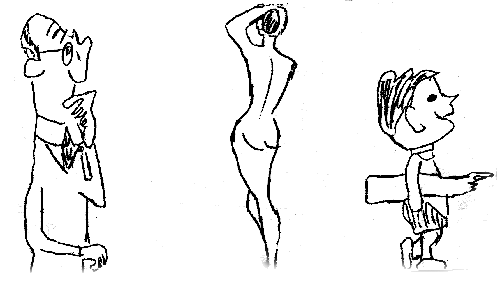
In so doing, we have obviously changed fonts, changed paragraphing and page-breaks etc. to make it more readable. That apart, it is quite faithful to the original, and contains no changes to the wording etc. In addition to the brochure, Val had carefully preserved a set of photographs. All the text is exactly as it was written, including sketches and cartoons, but Val's photographs and pictures have been dotted through it to turn it into a more readable document.
Sections are denoted by the Article Index on the top right of each page, but to read every page, one needs to use the <<Prev - Next>> links at the bottom of each page.
Finally, a belated report of the visit was published some 14 months after the event in the 1962 Greenhillian (click here) .
We wish that we were able to locate similar archives of other holidays/visits, but fear that few if any may share Val's sense of history; again, very many thanks, Val.
Foreword
by the Headmaster.
Ask any half-dozen people who travel abroad why they do it, and you might well get half-a-dozen different reasons. One man travels as part of his job, another may have a strong interest in foreign languages; a third may claim a curiosity about the way in which other people live, yet another may be attracted by an assurance of sunshine, blue skies and golden beaches. The mere fact of travelling may be a sufficient incentive for some, while others may claim rather vaguely that travelling broadens the mind.
Some people, I fear, travel abroad because it is "the thing".
Those of you for whom this brochure is produced may well have different reasons for joining this year's party; whatever they are, you will all share the excitement of preparation, the anticipation of sea and land travel and the manifold experiences of the holiday itself. The pleasure and profit which each of you can gain from it depend largely on your own attitudes - your ready acceptance of instructions, your co-operation with all other members of the party, your courtesey towards everybody - French or English, your determination to show yourself as a first-class "junior ambassador".
Much hard work has gone into the preparation for this holiday. The proper reward for hard work is success, and I am satisfied that with your enthusiastic co-operation the 1961 visit to Menton will be a memorable experience.
To all of you who meet at the departure point on Monday the 24th June, I wish "bon voyage". I hope to be in Oldham to welcome you back on your return.
| GENERAL TIME TABLE | ||
|
Mon. 24th July
Tues 25th "
|
10.30 hrs 18.30 " 23.59 " 04.30 " 05.00 " 07.00 "
|
Leave Oldham (West Street) High Tea, Chatham Restaurant, London Sail from Dover Arrive Ostend Leave Ostend. Breakfast. Hotel Moderne, Arras. Dinner, bed and breakfast Hotel Regina, Ars |
|
Wed. 26th "
Thurs. 3rd " |
07.00 " 19.00 " 07.00 " 18.00 "
20.30 " 01.00 " 05.00 " 06.30 " 14.00 " |
Depart Ars (packed lunch) via Dinner, bed and breakfast Hotel de Leave via route N7 (packed lunch). Dinner, bed and breakfast Hotel Leave for Ostend. Dinner, Hotel Boyal, Ostend, Depart Ostend. Arrive Dover Breakfast, Connaught Restaurant, Dover; Lunch, London Way Restaurant, Arrive Oldham (West Street) |
The journey to and from London will be via the motorway.
THE JOURNEY.
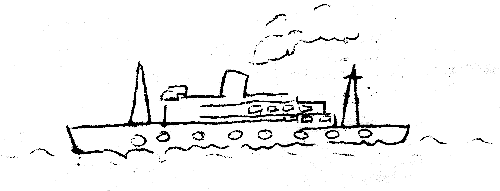
As will be seen from the time-table opposite, the first meal booked is in London. It will therefore he necessary to take a packed meal for the journey to London. It may also be advisable to provide a snack to be eaten on the boat.
For the journey you are advised to travel in something comfortable and which will stand up io three days of travel. Girls are requested not to wear shoes with stiletto heels in the coach as these may cause damage to the upholstery and fittings.
The coach proprietor does NOT allow chewing gum in the coach as this can easily spoil the upholstery.
Luggage should be limited as follows- one MEDIUM sized suit case - NOT of the expanding type - in which the bulk of your luggage will be transported. This will be stored in the coach boot for the whole of the outward and return journey. For overnight stops, a small case, for towel, soap, change of socks etc. will be kept inside the coach. It is clearly necessary to have overnight cases as SMALL as is practicable in view if the limited amount of space available. Rucksacks should NOT be used for luggage. Holdalls are permitted but cases are preferred as those will be easier to pack into the boat.
Once on board the cross channel steamer, you are advised to take the opportunity to rest as much as possible in view of the long drive on the following day. Claim your seats as soon as possible the outward journey.
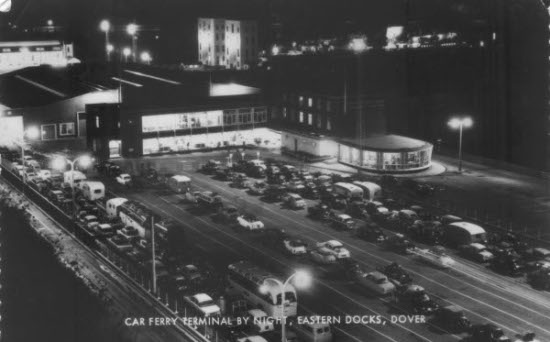
For the return journey berths have been obtained. Try to keep together as a party on embarking and landing - and be sure to collect your landing ticket from one of the members of staff.
NOTE. It will not be necessary to take more than few shillings in English currency. It is ILLEGAL to change English banknotes abroad, or to send banknotes out of the country by post. The co-operation of parents in this matter will be greatly appreciated,
SPENDING MONEY. Part of your spending money will be made available on arrival in France on the outward journey. The rest will be available on demand the day after we arrive in Menton.
YOU ARE ASKED TO CARRY OUT INSTRUCTIONS FROM MEMBERS OF STAFF PROMPTLY AND EFFICIENTLY. INSTRUCTIONS WILL NOT BE GIVEN UNLESS THEY ARE NECESSARY.

Notes on journey
You have not come on this journey to Yogi or read Virgil - these things are possible on DobX - so - look through the windows!
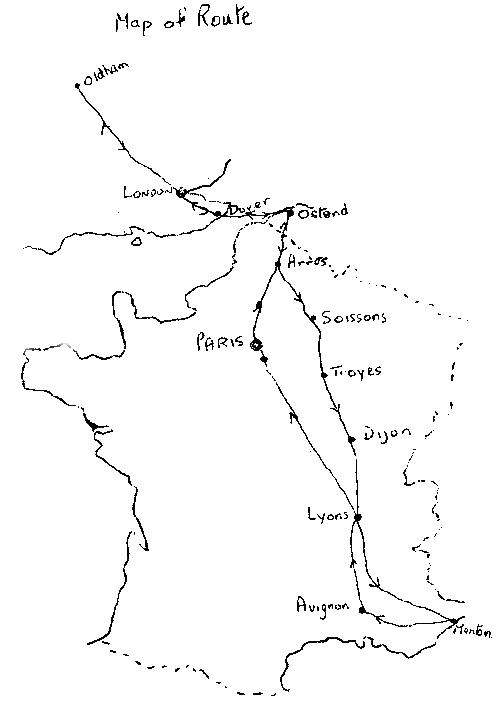
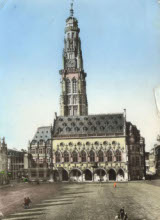 Out of Belgium into French Flanders - Pas de Calais Department. In the towns it is coal and cotton and cobbles - cruel during Tour de France - home from home - Vive les little-piecers francais! Breakfast in Arras, prefecture, county-town, as you might say, of Pas de Calais - Robespierre - French Revolution - dreadful man for his guillotine, born here - maybe soured by miserable northern climate - rolling plains - wheat, sugar beet, flax, hops, bovines and wars! they've been at it pretty well without stopping since Agincourt - (1415), quite near Arras - and before. You've heard of Dunkirk (1940).
All over Artois, next south of Flanders, and Picardy (or Somme) next south again - we're crossing the river Somme now - there was terrible fighting in both World Wars. At Mons is the Canadian War Memorial Vimy Ridge - and a British one at Soissons. Remember "Greengage Summer"? Interesting women took children to see these battlefields because they were slipping, as they grew up, into taking their peaceful lives for granted - 1916 -
"I stood on the firestep to watch the sky whitening. Sad and stricken the country emerged. I could see the ruined village below the hill and the leafless trees that waited like sentries. Down in the craters the dead water took a dull gleam from the sky. I stared at the tangles of wire and the leaning posts, and there seemed no sort of comfort left in life".
Well - just give it a thought.
Next river is Oise - this is an important agricultural region - sugar-beet, wheat, market gardening - then Soissons on the Aisne - its speciality is barley sugar - all that beet, I suppose -Well - er - no; it's at least as sticky as gum. Next we're over the Margeand into Champagne - sorry - no fizz in this part - I suppose that's why the French call it "Lousy Champagne" - fact! but there's a first-class cheese called Brie - rich country - huge farms.
Now into the Aube department, still in Champagne, on the Seine - sort of French Nottingham - birth-place of famous 12th Century poet Chretien de Troyes - wrote fascinating yarns about Lancelot and Yvain and that lot. Next land, well-wooded, rising into northern Burgundy to Dijon on the Cote d'Or department. Now we ought to see some vineyards, though Dijon's more famous for its mustard and museums - palace of the Dukes of Burgundy - and they do make a black-currant liqueur here called "cassis" - lovely stuff - now to Beaune in the heart of the Burgundy vineyards, famous for its hospital founded in the 15th Century - they have a 15th Century hospital ward preserved intact.
Vineyards, vineyards everywhere around here producing Nuits St.Georges, Pommard, etc. - wondered what those were. Grapes all the way into the Saone et Loire department, to Chalon sur Saone - first glimpse of river Saone soon (excuse me!) Chalon is a wlne-market-mechanical engineering-textiles-food. Down river to Macon - a river port. Lamartine, great 19th Century romantic poet - love and lakes - born here. Still down river - on your right the vine-clad Maconnais heights - to Villefranche in Franch - France. This one was formerly capital of Beaujolais now in the Rhône department -textiles-chemicals-iron and steel, then on to Ars sur Formans where we spend the night. St.Jean Baptiste Marie Oianney was priest of the parish from 1818 until his death in 1859 and in 1925 was canonized as the model and patron of parish priests. His house at Ars is now a place of pilgrimage. Next morning on to Lyon - at last we shall see the great Rhone - if only to cross it at this point.
Lyon - ancient capital of Gauls - famous annual international trade fair - ecclesiastical centre - about ¼ of city's population engaged in silk industry - dyeing and chemicals too. Now through Bas Dauphine - textiles - paper mills - into the pre-Alps - on our left the Grande Chartreuse mass - deep in it - Monastery founded by St.Bruno in 1084 - deep in monastery the monks secretly concoct famous liqueur known as chartreuse. On our right and a bit to South is the Vercors mass, here in 1944, 3,000 men of the maquis held out for two months against Germans who then inflicted terrible reprisals. Next Grenoble -
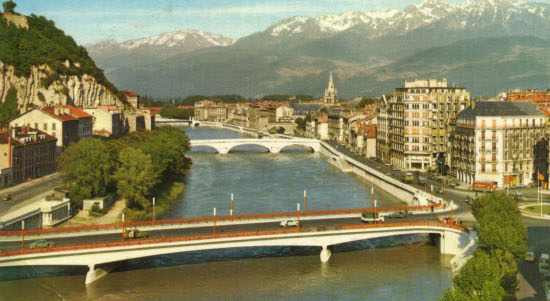
hive of industry - mettalurgy engineering - textiles, paper, gloves. Stendhal 19th Century novelist and Fantin Latour 19th Century portrait-painter born here. From here we're in the proper Hautes Alpes - artificial lake at le Sautet near Corps then over the top by the Bayard Pass - 1,246 metres - somewhere near here Napoleon - 100 days - and down to Gap - prefecture Hautes Alpes - then through Basses Alpes - Digne is the prefecture - hydro-electric installations at Castillion falls near Castellane - now at last provence-Grasse - flowers-perfume-olives-cypress-pine-SUN-
Van Gogh painted it.
| Our address in Menton will be...... | ||
|
Name.................... Greenhill Grammar School Party, Hotel Britannia and Beau Site, MENTON, France. |
||
| Postage Rates - | ||
|
TO FRANCE FROM FRANCE. |
Letters 6d. Letters Frs. 0.35 |
|
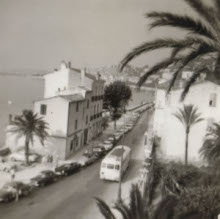
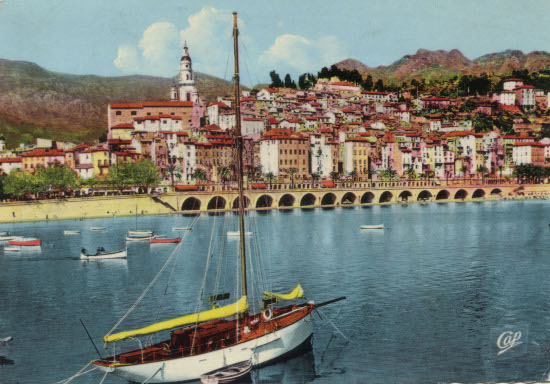
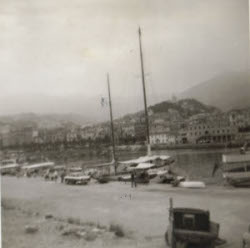
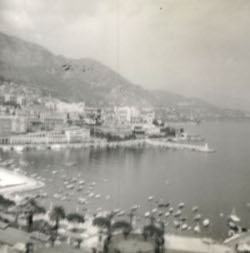
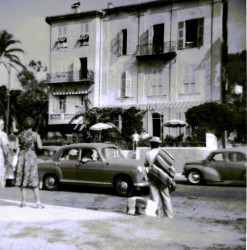 The Hotel is situated in Monton-Garavan Bay, standing in its own grounds on the Promenade facing the sea.
The hotel is surrounded by a large semi-tropical garden.
Garavan Bay is reputed to be the most beautiful bay along that part of the coast.
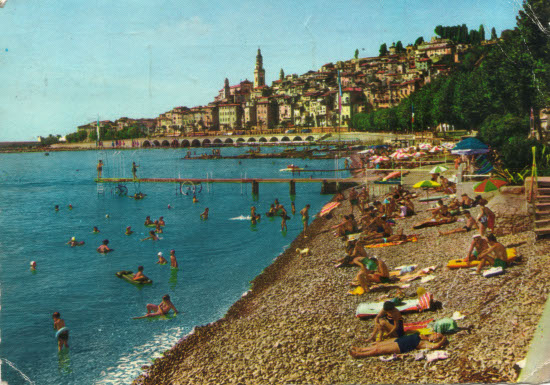
MENTON.
Menton is said to be the warmest resort on the coast.
It is sheltered from cold northerly winds which gives a climate suited to the growth of semi-tropical vegetation. The lemons of Menton are renowned.
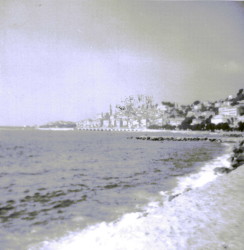 The old town is extremely picturesque with vaulted, switchback streets which have been well preserved leading from the port to the chateau. The Promenade George V widens into spacious terraces opposite the Casino Municipal,
Do not go swimming unless supervision has been arranged.
There will be plenty of opportunity to bathe when members of staff are present.
Take great care when sunbathing, especially if your skin blisters easily.
In case of cuts, bruises, etc. First Aid materials are available from members of staff.
In Hotels, spare a thought for the other residents and move about quietly.
Return:
From coast through Var department - sun-baked, barren country - sheep, lavender, garlic, bees, romanesque churches, house roofs with round tiles - might see Mont Ste Victoire made immortal by painting by Cezanne, born at next town - Aix - Bouches du Rhone department - highly historic - founded by Romans 123 A.D. can't stir for Roman remains in this part of France - some at Les Baux near here - bauxite for aluminium - first place where found - Aix, regal sort of town - kind of exotic Bath - it is a spa - Cezanne born here - speciality is a sweet like a lozenge of almond-paste called calissons - travelling west - that river must be Durance - strawberries, mellons, peaches, tomatoes - to Avignon on Rhone - prefecture Valenuse department - famous Vacluse spring, Petrarch wrote poem about it - land of the Arlesienne - Arles and Nimes are just south-west - bull-fights and passion - shoes and sweets - 14th Century Palace of Popes - massive walls and towers - sous le pont - 12th Century - half of it, anyway - no wonder - Rhone most powerful unpredictable river in Prance - National Company of Rhone exists to control it - wonderful dams - North to Orange - magnificent Roman theatre, amphitheatre and triumphal arch - speciality a wine, Chateauneuf-du-Pape.
Now into Drôme department - soft fruits and wines - to Donzere - hydro electric iinstallations - then Montelimar - more hydro electric installations - wine and nougat and house of 16th Century court-beauty Diane de Poitiers, Up Rhone valley - soft fruits, market gardening, always vineyards, through Valence - special wine - Hermitage - then back to Lyon - forgot to mention, first time round, birth-place of Mme Reamier 19th Century society beauty painted by David and Gerard - friend of most famous 19th Century pre-romantic romancer Chateaubriand.
Now West across Loire department to Roanne - ribbons, laces, gew-gaws - on the Loire - longest river in France - here it's only come about a quarter of its way. West again into the Allier department, past northern end of Monts de la Madeleine - northern extension of Massif central - then cereals and hay to Varennes - furniture - on the Allier. North now to Moulins, prefecture of Allier department - presumably home of 15th Century painter - offhand chap, told nobody his name - have to keep calling him Maitre de Moulins - painted exquisite- Autun nativity. North to Nevers on Loire - prefecture of Nievro department - wine and stock-breeding and watering places. China is the speciality of Nevers - its ducal palace - 15th Century and 16th Century - is one of chief surviving feudal buildings in central France - it also has a locomotive works.
North to Pouges les Eaux - a Spa, of course - diabetes and gout - then to Pouilly - famous white wine - then to Friare - canal which joins Loire and, Loing - (little tributary of Seine) crosses Loire here - next Montargis on Loing, shoes, macs, jewellery and honey - this is Loiret department, cereals and cattle.
Now Nemours - honey again. After Nemours we're with the Seine, in the Seine et Marno department - part of Ile de France - through forest of Fontainebleau - chateau built for Francis 1 - Nap.1. signed his abdication here in 1814. The school of Fontainebleau is a group of painters founded in France by Italians whom Francis 1 brought to decorate the chateau. Then Barbizon - another group of painters, 19th Century, this time - had their headquarters here - Corot, Rousseau, Millet, Daubigny and others - direct to fields and woods for inspiration.
At last - PARIS - Eiffel Tower, the Metro, bouquinistes, Moulin Rouge, etc., etc.
The following tables may be useful when shopping.
1 oz. - 28 grammes
4 oz. - 113 " 1 Kilo - 2 lb.3 ozs.
½ lb - 226 "
MONEY TABLES
(The values given are approximate)
£1.0.0........Frs. 13.5
10.0........Frs. 6.75
5.0........Frs. 3.50
2.6........Frs. 1.75
1.6........Frs. 1.00
9........Frs. 0.50
Before purchasing souvenirs etc, it is advisable to compare prices in various shops. This way you will get more for your money.
MAKE A NOTE OF IT.......
Remember to take great care of any documents entrusted to your care, e.g. Identity Cards,
Take great care of your luggage. It is NOT insured. You are responsible for your own property.
Meals provided in hotels do NOT include drinks.
LISTEN CAREFULLY TO INSTRUCTIONS - BE SURE TO BE IN THE RIGHT PLACE AT THE RIGHT TIME.
Try not to cause any damage. Damage MUST be reported at once. YOU are responsible.
Traffic in France drives on tho RIGHT. Remember this before crossing roads. Be particularly careful at level crossings, many of which are unguarded. Red light and/or bell indicate danger.
In restaurants, etc. remember that a 10% service charge is EXPECTED.
EXCURSIONS.
As we shall be staying close to the Italian Frontier, we shall visit Italy. The exact destination of this visit will be decided later.
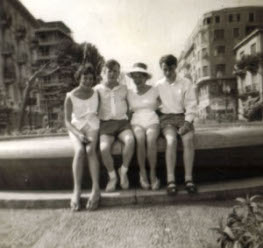
San Remo Jean Fielden, Ken Warren
Val Stokes, and David Webster
You will be able to change French money into Italian currency either at the Frontier or in the town visited. In the case of shops in towns near the border, French money may be accepted.
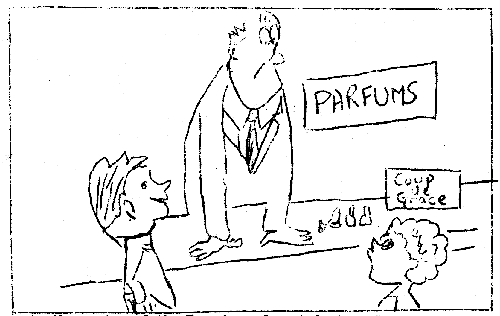
Grasse is the centre of the French perfume industry. The factories themselves are not open to tourists - the secrets of each company are jealously guarded. However, it is possible to gain some idea of the processes involved by visiting one of the perfumeries having a retail department in which demonstration apparatus has been installed.
Three main processes are involved - distillation - enfleurage and extraction. Distillation involves bringing water and flowers to boiling point in a still. The vapour is then condensed and collected. Enfleurage takes advantage of the fact that fatty materials become impregnated with the scent of flowers. The flowers are laid on a mixture of pork and beef fat. At the end of the season the fats are beaten with
 alcohol and this separates out the perfume leaving the "absolue pure de pommade."
In the third process the perfume is extracted by using a solvent. To obtain one kilogramme of essential oils needs about three quarters of a ton of rose blossoms.
The mention of Monte Carlo at once conjures up pictures of the Casino or of luxurious yachts lining the harbour.
The principality covers only 370 acres and the inhabitants do not pay taxes. Note that the Casino is in Monte Carlo - but the oldest part of the principality is the old town of Monaco, on the opposite side of ihe Condamine.
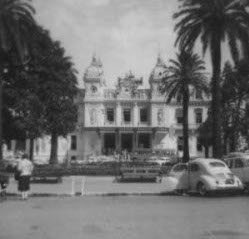
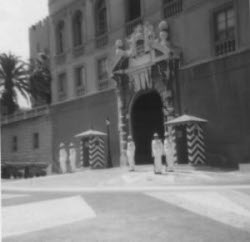
Monte Carlo - Casino Monte Carlo - Palace
Further (possibly optional) excursions may be arranged after arrival at Menton.
PARIS.
The return,journey includes an overnight stop in Paris and although time will be severely limited it should be possible to find time to visit some of the landmarks for which Paris is famous.
The morning of August 2nd will be available for sightseeing. Be careful not to get lost - we MUST leave Paris at the time stated in order to reach Ostend in time for the overnight boat.
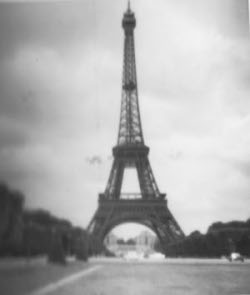
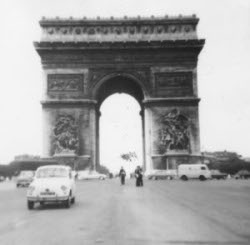
The morning excursion round Paris will certainly include the Eiffel tower and the Arc de Triomphe. Other famous landmarks will be included in the tour if time permits.
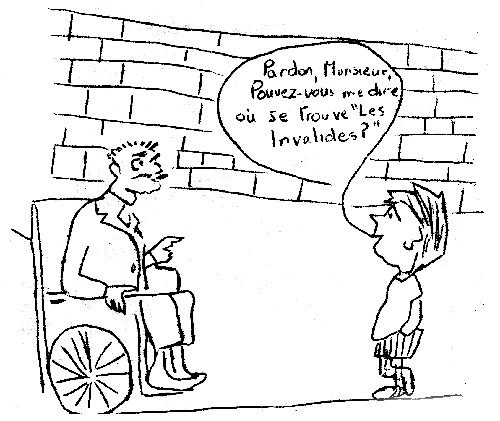
AT THE CUSTOMS.
All purchases made abroad must be declared. To speed Customs clearance you are asked to hand to one of the members of Staff a list of ALL purchases made abroad. A form will be supplied for this purpose.
NOTE. Travellers returning to this country carrying dutiable goods are only allowed to retain them (if declared) free of duty within certain limits.
1. Tobacco - up to ½lb. or 200 cigarettes.
2. Spirits (including liqueurs) up to ½ bottle.
3. Wine in bottle - 1 bottle.
4. Perfumed spirits and toilet waters - up
to ½ pint - of which not more than half
to be perfumed spirits.
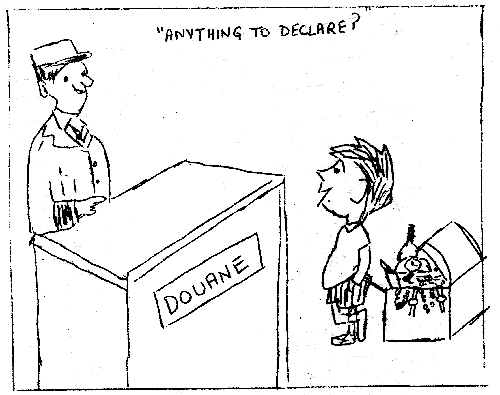
CUSTOMS NOTE.
ALL articles, including those listed on the opposite page MUST be declared in the first instance on your list of purchases, which will be presented to the Customs Officer for inspection. Duty will not necessarily be charged on small quantities of souvenirs but watches and photographic equipment will almost certainly involve payment of duty.
PLEASE REMEMBER TO BE PROMPT AT MEALS AND WHEN GOING ON EXCURSIONS.
And finally..........
DON'T FORGET TO WRITE HOME.
GENERAL NOTES.
We shall he together as a party for more than a week. During that time we shall be often in contact with the a general public. Please try to be:-
a. Polite and well mannered to all with whom we come into contact.
Remember that the English tourist will be judged by the way in. which we act.
Let people see us at our best.
b. Considerate to other people - not noisy or rough.
c. Unselfish. Others must be considered as well as ourselves.
d. Clean and tidy at all times.
e. Careful of our own possessions.
As we move about in public places try:-
a. To be careful - especially in heavy traffic.
b. To walk in an orderly manner. Do not take up ALL the pavement.
c. Not to lose anything.
In public buildings remember the golden rule
"DO NOT TOUCH".