
Articles
About Panoramas in General

During the relatively short life of Greenhill Grammar the photographic rationale seemed to be that a panoramic photo would be undertaken every five years. They showed the whole school body, staff and pupils, in our case around 500 people. A series of separate form, team etc. photos would be taken sometime in the interim so the in the normal five year period at the school each pupil would have the chance to have at least one record of their form and the whole school. Other Heads may have had different timings.
The panoramas were obviously more expensive to buy than the form photos and a lot fewer were produced. Also appropriate storage of such items was difficult to achieve. The standard size of image produced by the usual contractor, Panora, seems to have been 38 x 6 inches though the finished overall size varied from 40 to 42 inches long by 6 to 10 inches deep depending on surrounds and legends. The only place they could be kept flat was under lining paper in wide drawers or wardrobes where they were forgotten about and/or damaged anyway.
The most usual storage method seems to have been by rolling then holding with an elastic band. This invariably led to the exposed end becoming very dog eared and cut further and further along its length by the rubber band. Dampness spoils any old photograph due to various moulds and yeasts eating away the emulsion but rolled panoramas had an additional hazard in very dry atmospheres. The emulsion dried, became brittle over time, and shattered when it was unrolled. Under the circumstances we are lucky to be able to show so many complete examples of these items, especially the 1934 one, though in some cases this has been achieved by making composites of the best parts of examples from two different owners. Personal scanners generally available will scan a maximum length of 11.5 inches (A4 paper) so all the all the images on the site have been stitched from at least four, or up to six, individual scans to allow for edge effects and suitable jointing positions.
This type of photo could not be taken as a single short exposure as in a conventional camera and needed very specialised equipment. The aperture was a slot that exposed a short section of the group only and the camera panned along the whole length driven by a clockwork mechanism. From memory this took 15 to 20 seconds to pan along the whole group. The photographic film was drawn through the exposure gate by the same mechanism and synchronised to the camera movement. Although the resulting image is printed as a straight line the group was always arranged along a circular section for reasons of focus and perspective.
Due to this panning process and the fact that it took a relatively long time, a person who was fast on his feet could actually run behind the group to appear at both ends of the photo, especially with the collaboration of suitably placed friends. I have a panorama of the UCL engineering faculty with the same person at both ends achieved in this manner. Engineers are like that!
I was watching our local news recently and there was an item about a park that had been built in Plymouth in the 1930s to create employment during the depression of that era.
It got me wondering just how many local parks owe their origins to job creation schemes devised to combat periods of mass unemployment.
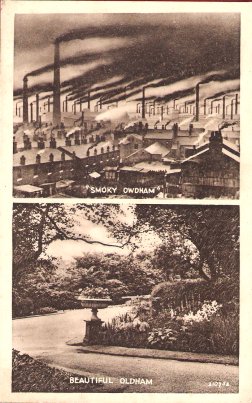 |
|
| Smoky Owdham , Beautiful Oldham (Unposted) |
Some of you will already know that Alexandra park was built in the 1860s to create employment for destitute cotton workers.
Below, for those who didn't know the reason behind the creation of the park is a potted history.
Because of the struggle for the abolition of slavery in North America, and the ensuing American Civil War in the mid nineteenth century, cotton exports from America to Europe almost ceased, and the mill towns of the North-West of England began to suffer.
Thousands of mill workers from, Oldham, Bury, Bolton and Rochdale, attended a meeting at the Free Trade Hall in Manchester voting overwhelmingly to support the abolitionists, even though this meant unemployment and probable starvation for their families.
The Oldhamers were later praised for their stand although riots broke out in many other towns in the North West.
The cotton famine of the 1860s created chronic unemployment in Oldham.
Many of the cotton workers were self-employed people who rented or owned parts of factories, working there for themselves.
They would have had little cash saved to tide them over this lean period.
By the summer of 1862 the Spinners' Union funds had run out and a Central Relief Fund was started.
Robert Ascroft, a wealthy Oldham mill owner, persuaded many of his friends to help in starting a job creation scheme to keep the town alive.
By 1863 a committee had been formed and with the help of a government loan and with the purchase of land at Swine Clough the creation of a park was planned.
This brought about the eventual creation of Alexandra Park.
A Park Committee was formed, and 72 acres of land at Swine Clough, a boggy area once used to house Oldhams pig population, was purchased from the Reverend John Cocker of Crompton, with a stipulation by the Reverend Cocker that the unemployed cotton workers were employed to do the work of creating the park.
Work began on the park and the first sod was cut in 1863 by the Mayor John Riley.
 |
|
| "eddief on 27 Feb 2011:- Here's a short report of the opening of Alexandra Park (or the Peoples New Park). The report is taken from the Penny Illustrated Paper of 9 September 1865. |
Men working on the park were provided with a free hot meal each day not only for themselves but also for their families, there was also a bread ration and milk for infants.
A soup kitchen was opened at The Working Men's Hall, with more soup kitchens soon opened.
It was reported that meals of porridge were served three times a day, but there is no confirmation of this, and other reports say that vegetable and occasional meat soups and stews were provided.
Local allotments provided vegetables which were used by, and traded between, the growers.
The vegetables were given to the communal kitchens to provide food for all the community.
The old and sick were also provided for.
As the land was cleared, the workers were given the trees and shrubs from the clearance, to use as fuel in their homes.
The park was opened on the 28th of August 1865 by the Mayor of Oldham, Josiah Radcliffe.
Oldham not only survived the hard times, but with the creation of Alexandra Park gained a wonderful asset.
The park was named Alexandra Park to celebrate the recent marriage of the Prince of Wales to Princess Alexandra of Denmark.
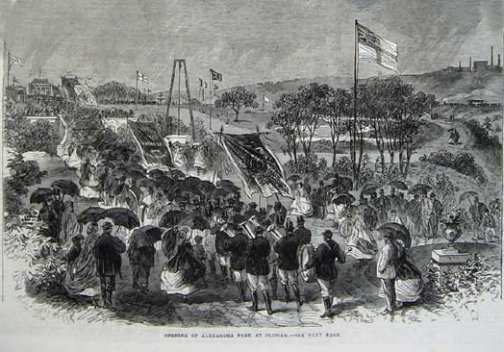 |
From an engraving showing the opening ceremony of the park.Lancashire Cotton Famine 28th of August 1865 |
|
|
Due to major changes in the site's operation in Dec 2017 the archives cn now only be accessed through the Bulletin Board. Select 'Discussion' in the Main Menu to open the Board Index page, then 'MSN Board Archive' in the header area
Backround/Timeline of the
MSN Archive
The original Greenhill Site was hosted on Microsoft's MSN Groups starting in May 2001, and that is where many members of the current site met up again for the first time since their schooldays.
Whilst being free and easy to use, MSN Groups were actually very restrictive in terms of what, and how much, could be done. For example, there were severe limits on:-
- Number of web pages
- Size of each page
- Storage allocation
- The HTML that could be used
- The Message Boards - really only functioned properly with Internet Explorer (ActiveX)
Another big concern to the technically-inclined was always the backup system. There wasn't one!
The content of the MSN site itself was easy enough to preserve, but the Message Boards were "something else". They were very "Microsoft proprietary", very complicated, and there was no documentation or back-up facility. The meaning of the technical term 'back-up' was not fully understood by many at the time and it was thought in some quarters that merely having a copy of each posting on a personal computer performed this function. This simplistic view however lacks the major function of a true back-up system - the ability to automatically re-constitute the original on the web. This re-construction should at least be possible on the original site, but a true back-up should allow re-installation anywhere on the web.
Work on the current site here at greenhill-gs.org.uk started in 2007, mainly to try to overcome the perceived shortcomings of "websites" hosted on MSN. The new site was kept aligned with the then already-existing Photo Site at greenhill-gs.co.uk, while MSN Groups continued to be used by the majority.
In October 2008, the catastrophe that had been feared came to pass - Microsoft announced that MSN Groups would close in February 2009.
The content of the MSN site itself was relatively easy to preserve, but the problem of the Message Boards and their 11,000+ posts remained - they were going to be lost.
Several members of this site, most notably Kevin, set about trying to salvage the situation, and the result is this archive.
The work was completed just prior to the MSN Groups closure, but not used because by then there had been an automatic migration of the MSN site to an organisation called Multiply.com - an "Official" Microsoft migration, in fact.
As if to illustrate our above fears about the difficulty of the back-up situation, that migration was patchy to say the least - web pages mixed with postings, loss of embedded images etc.
We were however persuaded that it was "good enough" as far as Message Boards were concerned, and that work would be done to tidy it up.
By 2013, no tidying had been done.
In December 2012 the multiply.com social networking service was withdrawn, and in May 2013 multiply.com ceased to exist altogether.
With it went the last vestiges of those MSN Message Boards.
Fortunately, and due to the foresight and hard work put in before MSN closed, we still had our 4½ year old MSN archive, and that at least, like the rest of the current site, can be and is properly backed-up. That archive is what you see here today.
The whole experience has in fact been an object lesson in the wisdom of relying on your own skills and resources rather than on corporate hand outs
Due to major changes in the site's operation in Dec 2017 the archives cn now only be accessed through the Bulletin Board. Select 'Discussion' in the Main Menu to open the Board Index page, then 'MSN Board Archive' in the header area
Description and Help
MSN Archive
When it came to preserving the MSN Groups Message Boards, it would of course have been nice to put them into a proper Bulletin Board on this site.
That was impossible, due to the non-standard, proprietary nature of the MSN system.
To save the day, Kevin invented this database system, and it works a treat.
Also, it is searchable. Simply click Search, and then enter your search word or phrase. N.B. the word or phrase is Case Sensitive.
When you click on Archive, you will get a screen like this, and you are invited to log in (at the top) with your usual login name and password. In that sense, this and our own BB are connected - same users, same password, and logging into one logs you into the other:-

You are presented with a list of threads.
The default is All Threads.
The MSN Boards comprised 7 forums:-
- General
- OLDHAM PUBS
- Reminiscences
- School Jokes
- Technical
- Tech Stuff
- Where are they?
You can leave the "Any" default, or filter threads by selecting a specific forum.
The thread titles can be sorted into any of the following orders:-
- Start Date (date of first post to the thread)
- Thread (Thread Titles in alphabetic order)
- Ref No of thread (Threads have references 1 through 730)
- Popularity (order by number of postings to that thread)
- End Date (Date of last post to the thread)
In addition, any selected order can be Ascending or Descending.
Also, there are 37 pages of threads (20 to a page) if "Any" is chosen. Clicking one of the 4 buttons on each side of the page number will step in single pages, or 5 pages a time, in either direction:-


Finally, one can choose to begin at either the start or the end of a thread:-

To actually read the postings, "First find your thread" (to paraphrase Mrs Beeton), and click on the little green block that contains its numerical Ref No (Now you need to be logged in):-

You are taken to that thread, and you can step through the posts in either direction, 1 at a time, 10 at a time, or 50 at a time, and to return to the list of threads, just click Select New Thread:-:-

It all sounds a bit cumbersome, but play for a few minutes and you will find that it's actually quite an efficient way of doing things.
Is it interesting? Is it useful? Was it worth the effort?
Probably not, but this was a once-and-for-all opportunity to preserve those 11,476 postings in 730 threads, and if we hadn't taken that opportunity it wouldn't have been offered for a second time.
Whatever, enjoy it, deride it, or dismiss it.
Those of us who worked on it don't mind which.
We are just content that when the crunch came, we stepped up to the plate and did it
Due to major changes in the site's operation in Dec 2017 the archives cn now only be accessed through the Bulletin Board. Select 'Discussion' in the Main Menu to open the Board Index page, then 'MSN Board Archive' in the header area
Developer's Notes on the MSN Archive
These notes are included for anyone with more than a passing interest in the archives. It is important for serious users to understand exactly what this system is and, perhaps more importantly, what it is not.
This is an attempt to conserve the messages posted by members of the Greenhill GS MSN Group, for the ex Greenhillian community as a whole, when the MSN service closed 23rd Feb 2009. Many members of this site were also members of the MSN Group.
The messages were extracted either from MSN directly or from mails sent by the group and held on personal machines. No attempt was made to replicate or mirror the MSN livery, presentation etc.
Making a true back-up of the MSN board was impossible for people other than MSN staff. The only public 'official' MSN transfer known to us was extremely deficient as regards both content and structure.
The process was not easy. It appears that MSN procedures, formats and servers changed many times after the inception of the group in May 2001. In addition the GGS board was particularly large for a system without even basic provisions for thread management.
The system contains approximately 11,500 messages which were harvested and extracted by software. Some of this was generally available on the web but required detailed configuration by us for this purpose. Other dedicated software was written by ourselves..
There may be small errors, particularly of formatting, introduced by this process but we believe that the content is essentially a faithful reproduction of the original.
In a very few instances, where we have had to change a message for technical reasons, a red 'archivist note' has been added as to the change and reason.
All processed messages have been read at least once (by very long suffering volunteer members of this site) and any unusual aspects checked against the original web item. In practice most messages have been checked by at least two people.
No attempt has been made to clean up or improve original presentation. <o:p></o:p> etc. was a characteristic feature of the MSN system.
At release date we have difficulty reproducing very specialist foreign characters, which appear as ????????. We have originals and can store them. Long term we have to find out how to feed them back to the browser client.
Images have been downloaded and conserved where available and a notice posted where they were not. Restricted space for members images was a problem for the MSN group, and prolific posters sadly had to delete early material to make room for later postings.
We have tried to conserve the MSN concept of 'Deleted' and 'Hmmm' pages in principle. Because of the circumstances however we cannot be certain to have reproduced these exactly in individual cases.
Deleting a page removed the content and the author, but left a marker in the system. This has been reproduced.
The Hmmm page could have several possible reasons. The message may just not exist, either through system error or deletion of a whole thread by a manager. Another reason could be that the message existed but the server took too long to find it.
It is possible that items may exist on this system which were shown as Deleted or Hmm in the final days of the group. This is due to material source and timing issues. Conversely items shown as Hmm may have existed on MSN but were too slow to open. We have, however, double checked against this known possibility.
The MSN system could tolerate duplicate (and more) thread titles. It was also very easy for novices to do start a duplicate inadvertently when replying to a post. This system cannot handle duplicates.
For our convenience, and I suspect users in general, duplicates have been suffixed in brackets. Only the bracket suffixes are ours. On occasions group members used similar tricks to avoid duplication when they knew it could happen.;
Kevin Dronsfield
Feb 2009