
Page 7 of 9
THE END ARRIVES
After all the facts and figures, dates results, names and reminiscences, one is still left with a wealth of detail unused, all of which affected the lives of the people in the School or reflected the achievements of those who had left.
For instance, school meals can be classed in the same category as mothers-in-law and Manchester weather, when subjected to schoolboy, or schoolgirl, humour and many comments must have been made about the meals during the last 67 years.
It was in April 1911 that the first meals were provided. (I think we're still served fish from the original catch!) 'A hot meal, two vegetables and sweet' at a cost of 6d, day. 2½p. for such culinary delights. In the first two weeks, an average of 34 children stayed each day, but I have no proof that they were the same 34 children every day.
You could bring your own dinner if you wished, provided you handed it in to Cook first thing in the morning, since you could NOT keep it in your locker. Locker keys, by the way, cost 6d. each. For those who could not survive until lunch time, a tuck shop was open at morning breaks.
This could be a record of Greenhill to-day except that 110 children stay to school dinners, locker keys cost 30p., the tuck Shop remains as popular as ever. Dinners, by the way cost 25p per day.
In 1936, the cost of meals was raised to l0d. a day, while in April 1936, the Governors agreed to increase the Cook's wages by 2/6 a week, but only by the Chairman's casting vote. Not a significant piece of information you may think, but I am sure that the extra 2/6 was significant to the Cook, whatever you may have thought of her meals !
School hours in 1909, and for long afterwards, were 9 a.m. to 12 and 2 p.m. to 4.30 p.m., with one to two hours homework, or 'Home Lessons', per night. The school holidays totalled eight weeks a year plus three half day mid-term breaks.
Uniform for the boys was cap and tie, while for the girls it was gym. slip, white blouses and straw sailor hats in the school colours and with a badge.
Those fortunate enough to win a prize for their excellence of work, received one to the value of 5/-, first prize and 3/6 second prize. To-day they are valued at 75P each.
These kind of details are trivial in themselves, but I find the similarity between 1909 and 1978 quite remarkable, with lockers, dinners, tuck shop, homework, uniform and prizes, though to-day we do enjoy longer holidays.
In May 1934, the Governors granted permission for the School to be organised into Houses. The names of the first four Houses were Viner, Lees, Handley and Joslin. The latter two were, of course, named after the retired Headmaster and his Deputy. Viner House was called after the Reverend Viner, who, as Chairman of the Board, had worked so hard to bring about the establishment of the Greengate Street building. 'Lees' was named after Dame Lees, Free-woman of Oldham and benefactress of the School.
Those who attended the School between 1934 and 1951 could be forgiven for believing that only one House ever won the Work and Games Trophy, since they tended to be won in blocks of years. For example, Handley were champions from 1935 – 1939, but won only once more in 1948. Viner were champions from 1940 - 1945, but never won it again, while Lees House were winners on only three occasions - 1946, 1947 and 1950. The unfortunate House though, was Joslin, which only succeeded in winning the trophy on two occasions - 1934, the year of its introduction, and 1949-
At Greenhill Grammar School, with fewer children, a Three house system was introduced. Lees was the only survivor of the original names and was joined by Walton and Fawsett. In the days of Greenhill Comprehensive the Houses became Lovell, Britten and Hillary until 1976, with the number on the roll reduced even further, these were reduced to two Houses - Walton and Churchill. Champion Houses no longer exists, but, whenever you attended the school, the best House of all was yours.
There remains so much unwritten, like Sergeant Major Brierley awarded the Croix de Guerre, Military Medal and Silver Star; Flying Officer lan Wilson who received the Oak Leaves; sketchy comments on sepia photographs - 'captured' 'missing', 'killed in action'. Harold Whipp, MBE, Donald Henry, who, in 1950, gained a place at the Unversity of Melbourne and John Broadbent, who was awarded his Ph.D. at Innsbruck University, which was not the only connection between that University and the Municipal.
In 1911, Innsbruck University appointed a young, first class honours graduate to lecture English. He resigned after one year, because 'he was homesick'. Those who knew Hartley Bateson may find that hard to believe, but he admitted it many years later.
No reference to the Greengate Street building would be complete without reference to Hartley Bateson, scholar, local historian, lecturer, racconteur, eccentric and teacher, which sound like a cue for 'This is Your Life'. He was these and many other things.
Born in Rossendale in 1888, the youngest of nine children, he attended Newchurch Grammer School until, at the age of 15, he was orphaned. Nevertheless, he became a pupil teacher, trekking across the moors to receive his own lessons between 8 and 9 a.m., after which he taught a class of 70.
Such a background was bound to produce determination which, allied to a brilliant brain, gained him his first class Honours degree at Manchester University, in 1911. Then followed his brief sojourn in Innsbruck. He was appointed to the Municipal School on January 1st 1914, at a salary of £130 p.a. He remained at the school until his retirement, except for two years' Army service from 1917 – 1919. In 1939, he was appointed Acting Principal Assistant Master.
He did claim that he only failed one interview. This happened when he applied for a post at London University translating Old English texts. At the end of the interview he left, taking the professor's hat by mistake. He was later informed, by an irate professor, that he had not been successful in his application.
His official 'History of Oldham' is the authoritative text on the town, but he withdrew his 'History of Saddle-worth' after a disagreement with the councillors of that village. Later, much later, he relented.
His hand-clapping walkabouts were a feature of his lessons, wandering round the room, out of the door, round the Hall and back again to Room 15 - and not one eye had strayed from the page.
Hartley Bateson represents only one of the legion of staff, who have taught at the school over the years, few of whom can be mentioned, but 'Daddy' Day and 'Beery Joe' evoke a few memories, as may 'good-looking' Mr. Ross and Joby Brierley. A fellow scientist was Mr. Turner, who turned physics into a nightmare for some - but he got results.
Mr. Childs, who chivalrously flourished his hat to the fifth form girls, and Miss Hall, pretty enough to turn any boy's head, Miss Moorfield and her ramblers through Snipe Clough. Who remembers M. Lappier's 'horny little hands'?
Tommy Loyd, 'who was probably a nice fellow really; he just looked and behaved like a prison warder', Johnny Barber, Bill Sobey and Mr. Shepherd - all remembered with affection, so they must have made their mark!
More recently, Mr. "Smoke Gets in Your Eyes' Hollos, and fellow sufferer Mr. Thompson. Mr. Briggs. Mr. Kent - "Dr. Who?' - and Mr. Prenton. Miss Sanderson who was labelled with 'Love Makes the World Go Round' - there must be a story there, and so ad infinitum. The list is endless, but unfortunately, the life of the School is not.
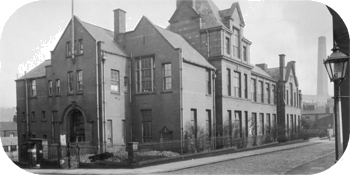
On Friday, July 28th. 1978, Greenhill School closes, but more than that, 75 years of education comes to an end. It began life as the Waterloo Board School and on that day in July, the old building meets its Waterloo.
For instance, school meals can be classed in the same category as mothers-in-law and Manchester weather, when subjected to schoolboy, or schoolgirl, humour and many comments must have been made about the meals during the last 67 years.
It was in April 1911 that the first meals were provided. (I think we're still served fish from the original catch!) 'A hot meal, two vegetables and sweet' at a cost of 6d, day. 2½p. for such culinary delights. In the first two weeks, an average of 34 children stayed each day, but I have no proof that they were the same 34 children every day.
You could bring your own dinner if you wished, provided you handed it in to Cook first thing in the morning, since you could NOT keep it in your locker. Locker keys, by the way, cost 6d. each. For those who could not survive until lunch time, a tuck shop was open at morning breaks.
This could be a record of Greenhill to-day except that 110 children stay to school dinners, locker keys cost 30p., the tuck Shop remains as popular as ever. Dinners, by the way cost 25p per day.
In 1936, the cost of meals was raised to l0d. a day, while in April 1936, the Governors agreed to increase the Cook's wages by 2/6 a week, but only by the Chairman's casting vote. Not a significant piece of information you may think, but I am sure that the extra 2/6 was significant to the Cook, whatever you may have thought of her meals !
School hours in 1909, and for long afterwards, were 9 a.m. to 12 and 2 p.m. to 4.30 p.m., with one to two hours homework, or 'Home Lessons', per night. The school holidays totalled eight weeks a year plus three half day mid-term breaks.
Uniform for the boys was cap and tie, while for the girls it was gym. slip, white blouses and straw sailor hats in the school colours and with a badge.
Those fortunate enough to win a prize for their excellence of work, received one to the value of 5/-, first prize and 3/6 second prize. To-day they are valued at 75P each.
These kind of details are trivial in themselves, but I find the similarity between 1909 and 1978 quite remarkable, with lockers, dinners, tuck shop, homework, uniform and prizes, though to-day we do enjoy longer holidays.
In May 1934, the Governors granted permission for the School to be organised into Houses. The names of the first four Houses were Viner, Lees, Handley and Joslin. The latter two were, of course, named after the retired Headmaster and his Deputy. Viner House was called after the Reverend Viner, who, as Chairman of the Board, had worked so hard to bring about the establishment of the Greengate Street building. 'Lees' was named after Dame Lees, Free-woman of Oldham and benefactress of the School.
Those who attended the School between 1934 and 1951 could be forgiven for believing that only one House ever won the Work and Games Trophy, since they tended to be won in blocks of years. For example, Handley were champions from 1935 – 1939, but won only once more in 1948. Viner were champions from 1940 - 1945, but never won it again, while Lees House were winners on only three occasions - 1946, 1947 and 1950. The unfortunate House though, was Joslin, which only succeeded in winning the trophy on two occasions - 1934, the year of its introduction, and 1949-
At Greenhill Grammar School, with fewer children, a Three house system was introduced. Lees was the only survivor of the original names and was joined by Walton and Fawsett. In the days of Greenhill Comprehensive the Houses became Lovell, Britten and Hillary until 1976, with the number on the roll reduced even further, these were reduced to two Houses - Walton and Churchill. Champion Houses no longer exists, but, whenever you attended the school, the best House of all was yours.
There remains so much unwritten, like Sergeant Major Brierley awarded the Croix de Guerre, Military Medal and Silver Star; Flying Officer lan Wilson who received the Oak Leaves; sketchy comments on sepia photographs - 'captured' 'missing', 'killed in action'. Harold Whipp, MBE, Donald Henry, who, in 1950, gained a place at the Unversity of Melbourne and John Broadbent, who was awarded his Ph.D. at Innsbruck University, which was not the only connection between that University and the Municipal.
In 1911, Innsbruck University appointed a young, first class honours graduate to lecture English. He resigned after one year, because 'he was homesick'. Those who knew Hartley Bateson may find that hard to believe, but he admitted it many years later.
No reference to the Greengate Street building would be complete without reference to Hartley Bateson, scholar, local historian, lecturer, racconteur, eccentric and teacher, which sound like a cue for 'This is Your Life'. He was these and many other things.
Born in Rossendale in 1888, the youngest of nine children, he attended Newchurch Grammer School until, at the age of 15, he was orphaned. Nevertheless, he became a pupil teacher, trekking across the moors to receive his own lessons between 8 and 9 a.m., after which he taught a class of 70.
Such a background was bound to produce determination which, allied to a brilliant brain, gained him his first class Honours degree at Manchester University, in 1911. Then followed his brief sojourn in Innsbruck. He was appointed to the Municipal School on January 1st 1914, at a salary of £130 p.a. He remained at the school until his retirement, except for two years' Army service from 1917 – 1919. In 1939, he was appointed Acting Principal Assistant Master.
He did claim that he only failed one interview. This happened when he applied for a post at London University translating Old English texts. At the end of the interview he left, taking the professor's hat by mistake. He was later informed, by an irate professor, that he had not been successful in his application.
His official 'History of Oldham' is the authoritative text on the town, but he withdrew his 'History of Saddle-worth' after a disagreement with the councillors of that village. Later, much later, he relented.
His hand-clapping walkabouts were a feature of his lessons, wandering round the room, out of the door, round the Hall and back again to Room 15 - and not one eye had strayed from the page.
Hartley Bateson represents only one of the legion of staff, who have taught at the school over the years, few of whom can be mentioned, but 'Daddy' Day and 'Beery Joe' evoke a few memories, as may 'good-looking' Mr. Ross and Joby Brierley. A fellow scientist was Mr. Turner, who turned physics into a nightmare for some - but he got results.
Mr. Childs, who chivalrously flourished his hat to the fifth form girls, and Miss Hall, pretty enough to turn any boy's head, Miss Moorfield and her ramblers through Snipe Clough. Who remembers M. Lappier's 'horny little hands'?
Tommy Loyd, 'who was probably a nice fellow really; he just looked and behaved like a prison warder', Johnny Barber, Bill Sobey and Mr. Shepherd - all remembered with affection, so they must have made their mark!
More recently, Mr. "Smoke Gets in Your Eyes' Hollos, and fellow sufferer Mr. Thompson. Mr. Briggs. Mr. Kent - "Dr. Who?' - and Mr. Prenton. Miss Sanderson who was labelled with 'Love Makes the World Go Round' - there must be a story there, and so ad infinitum. The list is endless, but unfortunately, the life of the School is not.
On Friday, July 28th. 1978, Greenhill School closes, but more than that, 75 years of education comes to an end. It began life as the Waterloo Board School and on that day in July, the old building meets its Waterloo.