
Page 6 of 9
THE BUILDING
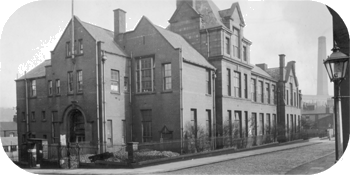
From its opening, in 1903, to the present day, the structural appearance of the Greengate Street building has changed very little. There are, in fact, only five changes, which can be noticed from outside.
In 1905, the caretaker's house, cancelled from the original school plans, in 1900, was approved by the Board of Education and two years later, by Oldham Education Committee.
In 1909, when the Municipal Secondary School moved into the building, it was essential that Science facilities be provided, so in that year, the Caretaker's house and the Science block were built.
The prefabricated building at the bottom of the girls' yard, which is now used, as a Woodwork Room, first appeared on plans in 1935, but it was not until 1947 that it was built, originally for use as the 'Remove' classroom. It was not fitted out as a woodwork room until 1951.
It was not until 1956 that the next addition was made. It is an interesting feature of the original architect's drawings that provision was made for the addition of a future teaching area to be built above Rooms 7 and 8 and opposite the Needlework room.. The room added was the Domestic Science Room, which meant that, from 1956 Woodwork and Cookery could be taught on the premises instead of at the Centre.
The final addition to the building was approved in February 1959, following a report in November 1958, which said that the toilets in the boys'yard were in an unsafe condition. It was decided, therefore, to demolish these, but, fortunately for the boys, not before new inside toilets had been built. Two landmarks - the toilets and the cycle shed - had disappeared, to be replaced by a gleaming, tiled extension.
Internally, a number of additions and alterations have been made, perhaps the most noticable being the stage in the Lower Hall, which was built by the Woodwork Department in 1954.
There were, though, a number of improvements recommended over the years, which, in fact, either never came to fruition or were deferred for a long period. For example, in 1931 alterations to the Mens' Staff Room were proposed, but it was 1961 before they were carried out, with the result that if you had to be 'dealt with' you had to report some ten yards to the right.
The more discerning of the pupils used to 'enjoy' school dinners in a room, or even on the corridor, near the gym. Later, a kitchen was built by the entrance to the Lower Hall, where the meals are now eaten.
The original dining area, near the gym, became the girls' changing room and in 1951 it was proposed to provide both the boys and the gils' changing rooms with showers. However, for economic reasons again, only the alterations to the girls' changing room were approved, in addition to the provision of storage space in the gym. itself.
On my first tour of the school, I remember very clearly thinking, when taken into the Physics laboratory, that this was were Sir Issac Newton learned his science, so it is not suprising to learn that, in June 1958, plans were submitted for a new two-storey Science block to be built opposite the boys' entrance into school.
The plans were never approved, so extra laboratory facilities were provided at Waterloo Secondary Modern.
Other changes in the school have been more in the nature of organisational alterations. When the School was first built, the Elementary School was housed on the first floor Mr. Fairnie's room was at the top of what became known as the 'girls' stairs'. After 1909, the room became the Ladies' Staff Room, a function which it carried out unti 1966, when the Mens' Staff Room became mixed.
What a mind-bending step that must have been!
Room 6, just past the Head's Office, was a conventional classroom until benches were installed to convert it into a Biology Lab. The benches were removed in 1975 and during the last three years it has been used as a television and recreational room.
The record for the most versatile room in the school however, must go to the basement room at the boys' end of the school. At present it is used for drama classes and small music groups. In the past, though, it has served as a classroom, stockroom, dining room, prefects' room and, during the war, 'the basement shelter'.
An H.M.I.'s report in 1934 was critical of the material condition of the building. Thirty-one years of wear and tear had left it unsuitable as a secondary school building and yet, for another thirty-four years the building, with minor alterations, has continued to house children successfully and without an air of deprivation.
The years have taken there toll, paint pealing off walls, rain dripping through the ceilings, doors that will not lock anymore and the ceiling collapsed two years ago and is now supported by an iron girder. For all that, however, it remains a strong building, obviously with a future function still to perform. Whatever happens to the bricks and mortar, nobody can eradicate the memories.
In 1905, the caretaker's house, cancelled from the original school plans, in 1900, was approved by the Board of Education and two years later, by Oldham Education Committee.
In 1909, when the Municipal Secondary School moved into the building, it was essential that Science facilities be provided, so in that year, the Caretaker's house and the Science block were built.
The prefabricated building at the bottom of the girls' yard, which is now used, as a Woodwork Room, first appeared on plans in 1935, but it was not until 1947 that it was built, originally for use as the 'Remove' classroom. It was not fitted out as a woodwork room until 1951.
It was not until 1956 that the next addition was made. It is an interesting feature of the original architect's drawings that provision was made for the addition of a future teaching area to be built above Rooms 7 and 8 and opposite the Needlework room.. The room added was the Domestic Science Room, which meant that, from 1956 Woodwork and Cookery could be taught on the premises instead of at the Centre.
The final addition to the building was approved in February 1959, following a report in November 1958, which said that the toilets in the boys'yard were in an unsafe condition. It was decided, therefore, to demolish these, but, fortunately for the boys, not before new inside toilets had been built. Two landmarks - the toilets and the cycle shed - had disappeared, to be replaced by a gleaming, tiled extension.
Internally, a number of additions and alterations have been made, perhaps the most noticable being the stage in the Lower Hall, which was built by the Woodwork Department in 1954.
There were, though, a number of improvements recommended over the years, which, in fact, either never came to fruition or were deferred for a long period. For example, in 1931 alterations to the Mens' Staff Room were proposed, but it was 1961 before they were carried out, with the result that if you had to be 'dealt with' you had to report some ten yards to the right.
The more discerning of the pupils used to 'enjoy' school dinners in a room, or even on the corridor, near the gym. Later, a kitchen was built by the entrance to the Lower Hall, where the meals are now eaten.
The original dining area, near the gym, became the girls' changing room and in 1951 it was proposed to provide both the boys and the gils' changing rooms with showers. However, for economic reasons again, only the alterations to the girls' changing room were approved, in addition to the provision of storage space in the gym. itself.
On my first tour of the school, I remember very clearly thinking, when taken into the Physics laboratory, that this was were Sir Issac Newton learned his science, so it is not suprising to learn that, in June 1958, plans were submitted for a new two-storey Science block to be built opposite the boys' entrance into school.
The plans were never approved, so extra laboratory facilities were provided at Waterloo Secondary Modern.
Other changes in the school have been more in the nature of organisational alterations. When the School was first built, the Elementary School was housed on the first floor Mr. Fairnie's room was at the top of what became known as the 'girls' stairs'. After 1909, the room became the Ladies' Staff Room, a function which it carried out unti 1966, when the Mens' Staff Room became mixed.
What a mind-bending step that must have been!
Room 6, just past the Head's Office, was a conventional classroom until benches were installed to convert it into a Biology Lab. The benches were removed in 1975 and during the last three years it has been used as a television and recreational room.
The record for the most versatile room in the school however, must go to the basement room at the boys' end of the school. At present it is used for drama classes and small music groups. In the past, though, it has served as a classroom, stockroom, dining room, prefects' room and, during the war, 'the basement shelter'.
An H.M.I.'s report in 1934 was critical of the material condition of the building. Thirty-one years of wear and tear had left it unsuitable as a secondary school building and yet, for another thirty-four years the building, with minor alterations, has continued to house children successfully and without an air of deprivation.
The years have taken there toll, paint pealing off walls, rain dripping through the ceilings, doors that will not lock anymore and the ceiling collapsed two years ago and is now supported by an iron girder. For all that, however, it remains a strong building, obviously with a future function still to perform. Whatever happens to the bricks and mortar, nobody can eradicate the memories.