
Page 5 of 9
CHANGING FACES
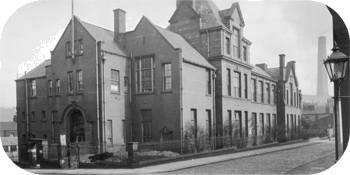
Names and faces changed of Staff, Pupils and the School, but possibly none more notable, with no disrespect to his successors, than that of Mr. G.M. Handley, who retired in 1933, after performing the duties as Headmaster of the Greengate Street Building since 1009. He set the tone of the School and its standards, for which he received unstinting praise from Inspectors, Staff and pupils alike. 'Firm but fair' is a description of him made by more than one former pupil, though perhaps some had more reason to agree with the former than with the latter.
Born in Rochdale and educated at Rochdale Grammar School and in London, he began teaching in 1889 at the Waterloo School in Hardy Street. In 1908 he was appointed as Head of the Municipal Secondary School and principal of the Teachers' Centre in Gower Street.
He was instrumental in bringing about the transfer of the School to Greengate Street and in successfully uniting his two posts under one roof.
He was noted for his powers of organisation and was recognised as a strong character with the 'vigour and energy to get what he wanted', from which the school benefitted in many ways. Outside school he was also active, as President of the Lyceum Theatre, member of the West End Bowling and of Werneth Golf Club, quite a coincidence, since the last Head of the School is also a keen golfer and bowler.
He always kept up to date with the curriculum and under his guidance, staff and pupils enjoyed greater freedom than was the case in most of the schools of his day, which was yet another feature of the School throughout its life.
Mr. Handley, upon retirement, received a radio, a cheque, the money from which funded the 'Handley Prizes', and a portrait which was displayed in the School for many years after.
He was succeeded by Mr. Butler, who held the position until 1937 and under whom some remarkable examination results were achieved. In 1934, all 26 entrants passed Chemistry, 22 with Distinction, a point noted in a letter of congratulations from the Governors to Messrs. Loyd and Chatterton.
Born in Rochdale and educated at Rochdale Grammar School and in London, he began teaching in 1889 at the Waterloo School in Hardy Street. In 1908 he was appointed as Head of the Municipal Secondary School and principal of the Teachers' Centre in Gower Street.
He was instrumental in bringing about the transfer of the School to Greengate Street and in successfully uniting his two posts under one roof.
He was noted for his powers of organisation and was recognised as a strong character with the 'vigour and energy to get what he wanted', from which the school benefitted in many ways. Outside school he was also active, as President of the Lyceum Theatre, member of the West End Bowling and of Werneth Golf Club, quite a coincidence, since the last Head of the School is also a keen golfer and bowler.
He always kept up to date with the curriculum and under his guidance, staff and pupils enjoyed greater freedom than was the case in most of the schools of his day, which was yet another feature of the School throughout its life.
Mr. Handley, upon retirement, received a radio, a cheque, the money from which funded the 'Handley Prizes', and a portrait which was displayed in the School for many years after.
He was succeeded by Mr. Butler, who held the position until 1937 and under whom some remarkable examination results were achieved. In 1934, all 26 entrants passed Chemistry, 22 with Distinction, a point noted in a letter of congratulations from the Governors to Messrs. Loyd and Chatterton.
In 1935, every boy in the Senior Examination class gained his Matriculation, while in the following year, the School enjoyed 80% examination successes, compared with the national average, for 1936, of 72.4%
In view of the criticism of the School's material condition, in an Inspectorate Report of 1934, the Governors recommended the building of a new school to house the Municipal High School, as the building had been named since 1930.
This recommendation, amongst others, led to the broader discussion to reorganise Secondary Education in the Borough. One idea considered was the merging of the boys of Hulme Grammar and the High School into one all-boys' school, while the girls would form another single sex school at Gower St. Had the pupils known about this I think they may have uttered a few strong objections. To divide the boys and girls by a wall is one thing, but to house them at opposite ends of the town was a different matter.
However, discussions were still continuing in 1937 when Mr. Butler resigned to take up a Headship elsewhere, so, because of the uncertainty of the situation, it was decided to appoint a temporary Head. The choice was Mr. Joslin, another prominent figure in the administration of the school from its opening in 1909.
Mr. Joslin, who had been Deputy Head since 1909, had retired in 1934, but was persuaded to come out of retirement for two years until reorganisation was carried out.
He is spoken of with the greatest respect by former pupils, who most commonly describe him as 'unflappable', while he made Maths seem merely a simple, logical exercise. He was very active in the field of Teachers' Associations, sitting as a representative on the Standing Joint Committee on the salaries of teachers, the result of which was the formation of the Burnham Committee, which today is still the body which decides teachers' salaries.
He performed great work on behalf of the Secondary School teachers, especially non-graduates and in 1924 was elected National President of the Secondary Teachers' Association, a body which he helped to form.
He carried out his duties as Headmaster with the usual efficiency expected of him, but by 1939, with reorganisation still no nearer settlement, he chose to return to his well
earned retirement.
However, by no means did he remain inactive, being in constant demand as a speaker at functions in the Oldham area, and, as a Rotarian, was still giving speeches in his eightieth year.
With reorganisation still unresolved, it was again decided to appoint an acting Headmaster, who, in fact, came to hold the post longer than anyone else, except Mr. Handley.
Mr. Joslin's successor as Deputy Head became his successor as Headmaster. Mr. Ashworth, appointed temporarily, came to hold the post until his retirement in 1951, when the School moved to Counthill. During his Headship, the School gained its fourth name - 'East Oldham High', no longer the only State selective school in the town.
In 1951, seventeen years after it had been first suggested the school moved into new premises and became Counthill Grammar School, but it was not the end of the Greengate Street Building by far. The pupils of West Oldham High School in Ward Street, moved into Greengate Street and the building took its fifth title - Greenhill Grammar School.
Mr. Higson became the Headmaster and by 1953 the School had 400 pupils on roll. In 1954, the first pupils sat 'A' levels and the most notable result was gained by Denis Elwell, who averaged 75% on all papers. He was awarded a State Scholarship to the Imperial College of Science and Technology.
In the same year, 49 candidates sat 'O' level, 22 of whom passed five or more subjects. The 350 subject entries resulted in a 50% success rate.
In January, 1963, Mr. Higson followed the path of former pupils of the building when he was appointed Headmaster of Counthill Grammar School. He was succeeded by Mr. Gray, an ex-Durham schoolboy and Mathematician, who had taught in Bradford, Eckington, Westfield and Bedworth. He was destined to act in one of the final scenes of the school's life as a selective school.
Perhaps one of the more noteable changes brought about during the years of Greenhill Grammar School was that it became more truly a co-educational establishment, even if that door did remain locked.
For much of its life from 1909, the pupils had been taught in single sex classes. The girls were taught almost exclusively by the mistresses and the boys by the masters, but from 1951 classes were mixed and were taught by men and women alike, although even in 1961 there was still a class of girls only.
Nevertheless, the idea of separate schools for girls and boys had been shelved and cloistering of girls and boys in separate classes was gradually relaxed. The final relaxation came in 1966.
'1966 and all that'. Yet another landmark in the building's history, but this time more dramatic than at any time since 1909 - Oldham went Comprehensive.
A new building at Street Farm was constructed to house two existing schools - Greenhill Grammar and Hollinwood Secondary Modern. Almost until its opening, the School was referred to as StreetFarm, but in fact it became known as Kaskenmoor, so yet another Oldham School received the offspring of the Greengate Street Building.
During their last year as separate schools, Hollinwood's Brass Band visited Greenhill, while the Grammar School's Dramatic Society gave a performance at Hollinwood of 'The Happiest Days of Your Life'.
So, in 1966, the Greengate School Building ceased to be a selective secondary school for the first time in 57 years. For a spell, in one sense, it lost something of its individual identity, because from 1966 to 1970 it formed an annex to Hathershaw School, with Mr. Vaughan in charge. It did suffer some of the problems of a split-site school, since it is rather difficult if you finish teaching at Hathershaw at 10 a.m. and you take your next class at Greengate Street at 10 a.m.
Gradually, however, these problems were ironed out and the staff were increasingly timetabled at Hathershaw or the Annex on a more permanent basis, and so, after four years, it was decided to reorganise yet again.
In 1966, some of the staff and children of the Clarksfield School had moved into the Greengate School building, but in 1970, it was decided, as a temporary measure, to allow Greenhill to exist again as a separate school in itsown right.
Hathershaw became a 14 - 18 year senior High School to be fed by Fitton Hill and Greenhill Schools, which were to teach children from 11 - 14 years, the pattern which has existed until to-day.
Initially, Mr. F. Horrocks was appointed as Headmaster of the newly-formed school, but, in fact, he never took up the post and in 1970 Mr. Jones became the eighth Headmaster of the School, taking up its seventh title.
Not only had the format of the School changed from 1966, but so had the composition of the intake, for Greenhill has become, during its final years, a truly multi-racial school, containing children whose parents were born in Eastern Europe, the West Indies, Pakistan, Bangladesh, India and Great Britain. It has been typical of the atmosphere of the school through the generations that, despite unfortunate attitudes displayed by sections of our society, the children of so varied a collection of races, colours and creeds, have managed to live together in relative harmony. This is of great credit to the staff, but the children must also take a great deal of praise for this situation.
Only two stages remain in the history of the School. In September 1973, Mr. Jones took up another appointment and was succeeded by his Deputy Head, Mr. Stanley, who became the ninth, and last Head of the School.
He had taught in Oldham for many years and originally came to Greenhill Grammar School as P.E. Master, in 1961. He was appointed as Deputy Head of Greenhill Comprehensive in 1970, and as Headmaster had the task of taking the School through the final years of its life, because that is the second remaining stage of its history - its closure.
In view of the criticism of the School's material condition, in an Inspectorate Report of 1934, the Governors recommended the building of a new school to house the Municipal High School, as the building had been named since 1930.
This recommendation, amongst others, led to the broader discussion to reorganise Secondary Education in the Borough. One idea considered was the merging of the boys of Hulme Grammar and the High School into one all-boys' school, while the girls would form another single sex school at Gower St. Had the pupils known about this I think they may have uttered a few strong objections. To divide the boys and girls by a wall is one thing, but to house them at opposite ends of the town was a different matter.
However, discussions were still continuing in 1937 when Mr. Butler resigned to take up a Headship elsewhere, so, because of the uncertainty of the situation, it was decided to appoint a temporary Head. The choice was Mr. Joslin, another prominent figure in the administration of the school from its opening in 1909.
Mr. Joslin, who had been Deputy Head since 1909, had retired in 1934, but was persuaded to come out of retirement for two years until reorganisation was carried out.
He is spoken of with the greatest respect by former pupils, who most commonly describe him as 'unflappable', while he made Maths seem merely a simple, logical exercise. He was very active in the field of Teachers' Associations, sitting as a representative on the Standing Joint Committee on the salaries of teachers, the result of which was the formation of the Burnham Committee, which today is still the body which decides teachers' salaries.
He performed great work on behalf of the Secondary School teachers, especially non-graduates and in 1924 was elected National President of the Secondary Teachers' Association, a body which he helped to form.
He carried out his duties as Headmaster with the usual efficiency expected of him, but by 1939, with reorganisation still no nearer settlement, he chose to return to his well
earned retirement.
However, by no means did he remain inactive, being in constant demand as a speaker at functions in the Oldham area, and, as a Rotarian, was still giving speeches in his eightieth year.
With reorganisation still unresolved, it was again decided to appoint an acting Headmaster, who, in fact, came to hold the post longer than anyone else, except Mr. Handley.
Mr. Joslin's successor as Deputy Head became his successor as Headmaster. Mr. Ashworth, appointed temporarily, came to hold the post until his retirement in 1951, when the School moved to Counthill. During his Headship, the School gained its fourth name - 'East Oldham High', no longer the only State selective school in the town.
In 1951, seventeen years after it had been first suggested the school moved into new premises and became Counthill Grammar School, but it was not the end of the Greengate Street Building by far. The pupils of West Oldham High School in Ward Street, moved into Greengate Street and the building took its fifth title - Greenhill Grammar School.
Mr. Higson became the Headmaster and by 1953 the School had 400 pupils on roll. In 1954, the first pupils sat 'A' levels and the most notable result was gained by Denis Elwell, who averaged 75% on all papers. He was awarded a State Scholarship to the Imperial College of Science and Technology.
In the same year, 49 candidates sat 'O' level, 22 of whom passed five or more subjects. The 350 subject entries resulted in a 50% success rate.
In January, 1963, Mr. Higson followed the path of former pupils of the building when he was appointed Headmaster of Counthill Grammar School. He was succeeded by Mr. Gray, an ex-Durham schoolboy and Mathematician, who had taught in Bradford, Eckington, Westfield and Bedworth. He was destined to act in one of the final scenes of the school's life as a selective school.
Perhaps one of the more noteable changes brought about during the years of Greenhill Grammar School was that it became more truly a co-educational establishment, even if that door did remain locked.
For much of its life from 1909, the pupils had been taught in single sex classes. The girls were taught almost exclusively by the mistresses and the boys by the masters, but from 1951 classes were mixed and were taught by men and women alike, although even in 1961 there was still a class of girls only.
Nevertheless, the idea of separate schools for girls and boys had been shelved and cloistering of girls and boys in separate classes was gradually relaxed. The final relaxation came in 1966.
'1966 and all that'. Yet another landmark in the building's history, but this time more dramatic than at any time since 1909 - Oldham went Comprehensive.
A new building at Street Farm was constructed to house two existing schools - Greenhill Grammar and Hollinwood Secondary Modern. Almost until its opening, the School was referred to as StreetFarm, but in fact it became known as Kaskenmoor, so yet another Oldham School received the offspring of the Greengate Street Building.
During their last year as separate schools, Hollinwood's Brass Band visited Greenhill, while the Grammar School's Dramatic Society gave a performance at Hollinwood of 'The Happiest Days of Your Life'.
So, in 1966, the Greengate School Building ceased to be a selective secondary school for the first time in 57 years. For a spell, in one sense, it lost something of its individual identity, because from 1966 to 1970 it formed an annex to Hathershaw School, with Mr. Vaughan in charge. It did suffer some of the problems of a split-site school, since it is rather difficult if you finish teaching at Hathershaw at 10 a.m. and you take your next class at Greengate Street at 10 a.m.
Gradually, however, these problems were ironed out and the staff were increasingly timetabled at Hathershaw or the Annex on a more permanent basis, and so, after four years, it was decided to reorganise yet again.
In 1966, some of the staff and children of the Clarksfield School had moved into the Greengate School building, but in 1970, it was decided, as a temporary measure, to allow Greenhill to exist again as a separate school in itsown right.
Hathershaw became a 14 - 18 year senior High School to be fed by Fitton Hill and Greenhill Schools, which were to teach children from 11 - 14 years, the pattern which has existed until to-day.
Initially, Mr. F. Horrocks was appointed as Headmaster of the newly-formed school, but, in fact, he never took up the post and in 1970 Mr. Jones became the eighth Headmaster of the School, taking up its seventh title.
Not only had the format of the School changed from 1966, but so had the composition of the intake, for Greenhill has become, during its final years, a truly multi-racial school, containing children whose parents were born in Eastern Europe, the West Indies, Pakistan, Bangladesh, India and Great Britain. It has been typical of the atmosphere of the school through the generations that, despite unfortunate attitudes displayed by sections of our society, the children of so varied a collection of races, colours and creeds, have managed to live together in relative harmony. This is of great credit to the staff, but the children must also take a great deal of praise for this situation.
Only two stages remain in the history of the School. In September 1973, Mr. Jones took up another appointment and was succeeded by his Deputy Head, Mr. Stanley, who became the ninth, and last Head of the School.
He had taught in Oldham for many years and originally came to Greenhill Grammar School as P.E. Master, in 1961. He was appointed as Deputy Head of Greenhill Comprehensive in 1970, and as Headmaster had the task of taking the School through the final years of its life, because that is the second remaining stage of its history - its closure.