
Page 3 of 9
ACADEMIC RECORD
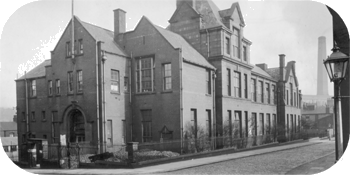
Whatever fees were paid or salaries received, two major factors combined to prove the success of the school - - its atmosphere and academic record. It is too easy to eulogise about what a happy school it was, and is, but academic attainment can be illustrated by the achievements of its pupils, supported by the views of visitors to the school.
In 1914, 1922 and again in 1934, the. school was subjected to lengthy and vigourous examinations by members of His Majesty's Inspectorate. The reports were full of praise for the Head, his Staff and the industry of the pupils. Similar reports are to be found throughout the School's life.
The teaching of P.E. and Science gained the highest and most consistent praise, which was reinforced by the high proportion of pupils who became Science graduates, though Mr. Handley did discourage girls from taking Sciences when options had to be decided!
From 1909 - 1966, the school was a selective secondary school. During that time it produced an avarage of ten graduates and seventeen teachers a year. In all, 31% of the School's former pupils gained either a degree or Teaching Certificate.
The relationship between economic conditions and the number of pupils entering University or Training College produced a distinct pattern. During the slump and war years from 1935 to 1945, an average of only six former pupils graduated while in 1949, the school produced 18 graduates, the best year of its life. During the war, only three ex-pupils per year graduated.
The number of higher degrees awarded to former pupils is also a source of pride. Thirty-four gained Master's degrees, while eight received Doctorates: Thomas Royds, John Broadbent in 1911; Arthur Redford in 1922: Eric Eastwood in 1935; Ronald Cooper 1947; James Whitworth in 1949; Thomas Ashton in 1950 and Donald Brooks in 1963.
The School had a tradition for producing teachers from its days as a Pupil Teacher's Centre and during its life was responsible for providing the system with over a thousand teachers, many of whom gained extremely high and influential posts within the education system.
A remarkable number of former pupils returned, after training, to teach in Oldham, often for the whole of their careers illustrating the remarkable loyalty displayed by Oldhamers for their town. Many became Heads of schools in the town, for instance Phyliss Bennett, who, as Headmistress of Fitton Hill Junior School, was responsible for the introduction of the I.T.A. Reading Scheme. Clifford Bell became Headmaster of Hathershaw Technical School, and Mr. Higson, a former Municipal School pupil, returned to become the first Headmaster of the Greenhill Grammar School. The list is almost endless.
Some, however, gain positions of high authority outside the confines of a school. Miss Mycock became, amongst other things, Principal of the Manchester College of Education, while Jack Wrigley became Professor of Education at Reading University.
The late Sir Percy Lord was one of three former pupils to be knighted. He attended the school from 1914 to 1921 and returned to teach Chemistry from 1927 to 1932. He finally gained one of the country's most influential educational posts as Chief Education Officer of the old Lancashire Education Authority.
Albert Royds achievements have been mentioned earlier, but these few names serve to illustrate the range of influence exerted upon the national education scene by former pupils of the school.
Education, however, was not the only field in which Old Boys and Girls made their mark. Harold Jagger (1925) later became a Wing Commander, Roy Bottomley works at London Weekend Television and, in 1949 Dorothy Schofield was rated as the country's foremost female authority on Rader.
The list could continue for ever, adding people of local note such as Miss Moorhouse, Stanley Stretch, Ethel Dunkerley, Nellie Brieley, Marion Ogden, Ida Tweedale, Maud Collins, Gladys Charnock, J.T. Hilton, Gordon Maxwell and John Stafford.
The problem with such a list is that some notable personalities are bound to be missed, but the Roll of Honour of the School would be such as to warrant a book by itself. To the many who remain unmentioned, my apologies - unmentioned but not forgotten.
This, of course, emphasises the immense contribution made by the school, through its former pupils, to society
not only locally but nationally, even internationally, with former pupils as far afield as Canada, the U.S.A. , South Africa, Zambia, Australia and Shaw.
A school which set such high standards yet generated such affection, loyalty and friendship was bound to produce people who were to reach the top of their chosen career. Amidst such success, one former pupil rose to become possibly the school's most famous Old Boy.
On July 26th. 1978, two days before the School closed its doors for the last time, Sir Walter Winterbottom presented the Prizes at the final Speech Day.
Sir Walter Matriculated in 1929 and was awarded a Student Teachership. Two years later he gained a place at Chester Training College. Highlights amongst his later achievements were his period as manager of the England soccer team and, until his retirement earlier this year, his directorship of the National Sports Council.
In 1914, 1922 and again in 1934, the. school was subjected to lengthy and vigourous examinations by members of His Majesty's Inspectorate. The reports were full of praise for the Head, his Staff and the industry of the pupils. Similar reports are to be found throughout the School's life.
The teaching of P.E. and Science gained the highest and most consistent praise, which was reinforced by the high proportion of pupils who became Science graduates, though Mr. Handley did discourage girls from taking Sciences when options had to be decided!
From 1909 - 1966, the school was a selective secondary school. During that time it produced an avarage of ten graduates and seventeen teachers a year. In all, 31% of the School's former pupils gained either a degree or Teaching Certificate.
The relationship between economic conditions and the number of pupils entering University or Training College produced a distinct pattern. During the slump and war years from 1935 to 1945, an average of only six former pupils graduated while in 1949, the school produced 18 graduates, the best year of its life. During the war, only three ex-pupils per year graduated.
The number of higher degrees awarded to former pupils is also a source of pride. Thirty-four gained Master's degrees, while eight received Doctorates: Thomas Royds, John Broadbent in 1911; Arthur Redford in 1922: Eric Eastwood in 1935; Ronald Cooper 1947; James Whitworth in 1949; Thomas Ashton in 1950 and Donald Brooks in 1963.
The School had a tradition for producing teachers from its days as a Pupil Teacher's Centre and during its life was responsible for providing the system with over a thousand teachers, many of whom gained extremely high and influential posts within the education system.
A remarkable number of former pupils returned, after training, to teach in Oldham, often for the whole of their careers illustrating the remarkable loyalty displayed by Oldhamers for their town. Many became Heads of schools in the town, for instance Phyliss Bennett, who, as Headmistress of Fitton Hill Junior School, was responsible for the introduction of the I.T.A. Reading Scheme. Clifford Bell became Headmaster of Hathershaw Technical School, and Mr. Higson, a former Municipal School pupil, returned to become the first Headmaster of the Greenhill Grammar School. The list is almost endless.
Some, however, gain positions of high authority outside the confines of a school. Miss Mycock became, amongst other things, Principal of the Manchester College of Education, while Jack Wrigley became Professor of Education at Reading University.
The late Sir Percy Lord was one of three former pupils to be knighted. He attended the school from 1914 to 1921 and returned to teach Chemistry from 1927 to 1932. He finally gained one of the country's most influential educational posts as Chief Education Officer of the old Lancashire Education Authority.
Albert Royds achievements have been mentioned earlier, but these few names serve to illustrate the range of influence exerted upon the national education scene by former pupils of the school.
Education, however, was not the only field in which Old Boys and Girls made their mark. Harold Jagger (1925) later became a Wing Commander, Roy Bottomley works at London Weekend Television and, in 1949 Dorothy Schofield was rated as the country's foremost female authority on Rader.
The list could continue for ever, adding people of local note such as Miss Moorhouse, Stanley Stretch, Ethel Dunkerley, Nellie Brieley, Marion Ogden, Ida Tweedale, Maud Collins, Gladys Charnock, J.T. Hilton, Gordon Maxwell and John Stafford.
The problem with such a list is that some notable personalities are bound to be missed, but the Roll of Honour of the School would be such as to warrant a book by itself. To the many who remain unmentioned, my apologies - unmentioned but not forgotten.
This, of course, emphasises the immense contribution made by the school, through its former pupils, to society
not only locally but nationally, even internationally, with former pupils as far afield as Canada, the U.S.A. , South Africa, Zambia, Australia and Shaw.
A school which set such high standards yet generated such affection, loyalty and friendship was bound to produce people who were to reach the top of their chosen career. Amidst such success, one former pupil rose to become possibly the school's most famous Old Boy.
On July 26th. 1978, two days before the School closed its doors for the last time, Sir Walter Winterbottom presented the Prizes at the final Speech Day.
Sir Walter Matriculated in 1929 and was awarded a Student Teachership. Two years later he gained a place at Chester Training College. Highlights amongst his later achievements were his period as manager of the England soccer team and, until his retirement earlier this year, his directorship of the National Sports Council.