
THEY'RE CLOSING THE OLD SCHOOL DOWN
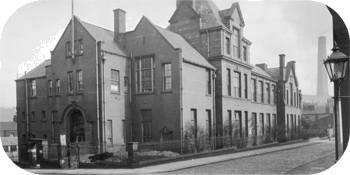
This is quite a lengthy and comprehensive essay by Rod Ashworth, which he wrote at the time of the school closure in 1978. Rod was the Deputy Head at the time.
One copy of this document is owned by Jeremy Sutcliffe, who found it amongst his mother's possessions (Ida Sutcliffe, neé Tweedale), and another copy is owned by David and Val Webster, who were present at the closure Open Day and received their copy there.
I N T R O D U C T I O N
Compile a History of Greenhill! In my ignorance I assumed 'Greenhill' and the Greengate Street building to have been synonymous for the past 75 years. How soon I learned my mistake and yet this school may smell as sweet by any other name, seven names in all. Apart from which I haven't seen, let alone smelt, the local tom-cat for a while now.
Generations of children and staff, thousands of lives shaped, memories given birth, of rewards and punishments, of humour and sadness, enjoyment, romance and, even here, boredom.
Secretly-made rendezvous with members of the opposite sex, whispered on corridors, scrawled notes while avoiding waspish mistresses or hawk-eyed masters - where has all the excitement gone ?
Girls in sight yet untouchable. Boys so close yet unattainable - well, maybe! Boys and girls under one roof and one Headmaster, yet as far apart as Mars and Venus, warriors and maidens kept apart by the warders, or protectors, depending upon your opinion of the role of the staff.
Boys' yard and girls' yard and ne'er the twain shall meet. Even the door was locked. (There isn't even a door now!)
Girls rushing to be first out of the form rooms in order to stand next to the boys in assembly, or casting hopeful glances over their shoulder as they crossed the yard - the boys in the science lab. may be watching, with any luck.
What was in that "obscene letter' circulated amongst her 'school fellows', by a girl in IIIB in 1911? Whatever it was, her father was given the option to remove his daughter from the school or have her expelled. He chose the former option. The 'girl' must be around 80 now. I wonder if she remembers? I know her name, but I'm not telling!
How many remember an occasion in 1919/20, when the whole school was assembled before Mr. Handley, in order that he might castigate one J.M.K. Faulkner, who, apart from his skills as a footballer and his claims to being the worst lad in the school, considered himself to be something of an explosives expert.
Apparently he had a stock of gunpowder, the use of which he demonstrated to some of his friends, one lunch time. One attempt to light the gunpowder failed, so his pals decided to have another go. It worked, but he failed to retire, which cost him his eyebrows and some hair.
Undeterred, the expedition, minus one, continued on its explosive way, by attempting to blow up the Waterloo School on Hardy Street. As with Guy Fawkes and his plotters, the attempt failed and they were captured. Fortunately, hanging, drawing and quartering had ceased to be a punishment in Oldham schools, but maybe the plotters regretted this after Mr. Handley had dealt with them.
Few people took liberties with Mr. Handley, who was described, many years after as 'fair but firm'. Mattie Ellison, however, had the temerity to stick her tongue out at him, presumably not to his face, but why she did it is 'another story'. Somebody noticed and admired her courage and immediately fell in love with her. He was Albert Royds, later Chief Education Officer in Rochdale, and who shares the distinction, with Hartley Bateson, of having a road named after him - Albert Royds Street in Rochdale. Bateson Way, in Oldham, took its name from the former member of the Secondary School staff.
So far one must have gained the impression that the school revolved around sex, violence and obscenity, which are the only topics mentioned so far. This would hardly be a fair conclusion, especially since Biology failed to appear on the timetable until September 1933. A month later a Boy Scout troop was formed by Mr. Nixon and (a week later) a Girl Guide troop was formed by Miss Jones and Miss Wilson. I am sure that this succession of events was purely coincidental.
Recollections of school days are divided between one-off incidents like the 'Great Muffin Fight' and traditions such as initiation ceremonies, de-tufting girls' berets, 'Running the Gauntlet' in one corner of the Boys' yard or even worse in another corner. Favourite haunts, often out of bounds, have continued down to this present day. I wonder how many boys, and girls for that matter, have 'fallen' into the Boating Lake in Alexandra Park during lunch time.
The corner shops are still out of bounds at break times, but children still go - some are caught, some escape. Pious pronouncements of dire consequences are still uttered in assemblies and they still work - for a day, or oven two. How many of you have foregone the delights of school dinners, pocketed the money and bought fish and chips, or chips and cigarettes?
The maze of back alleys or the spaces behind the Science Labs and Woodwork shed are still the favourites for quick drags with look-outs providing ample warning if danger approaches. Hands up if you've been caught unawares and kept talking by a member of staff, while you held a lighted cigarette in your pocket, trying to look innocent with smoke drifting out of your wrist. Mr. Hollos was never caught like that, but then he was a member of staff.
These and many other incidents could have happened at any other school, maybe, but they didn't, they happened at the Municipal or High School or Grammar School or Greenhill - the Greengate Street building, which has housed 75 years of children, staff and memories. It has enjoyed an atmosphere remarkably consistent through the years. Any attempt to recapture this atmosphere can only be partially successful, especially since the best years of the School were when you were there.
What is to follow is a largely a chronological account of the school's development and changes, but during my investigations I have been amazed by the interest generated by the project and the wealth of material supplied by people. I have always met with tremendous help and co-operation. To everyone who has assisted in any way, my sincere thanks. My only hope is that I have done a modicum of justice to the material provided.
THE EARLY YEARS – ELEMENTARY TO MUNICIPAL
So wrote Sir J. Kay Shuttleworth in 1886. It was this attitude which led to the passing of Forster's Education Act in 1870, the first major step in realising the ideal of education for the masses. It was the execution of this attitude which was to generate success in the Greengate Street Building.
The next major step in educational legislation came in 1902, which encouraged the provision of 'Post Primary' education by local authorities, a provision which Oldham had made before 1902.
G.M. Handley took up his first teaching post in 1889 at the Waterloo School, Hardy Street, which was in the process of changing from a full-time Elementary School to a Higher Grade School. There became, therefore, the need for an Elementary school in the area and so, on June l0th, 1899, approval was given to the ground plan bordered by Harmony, Greengate, Churchill and Waterloo Streets.
The architect, Richard Holt, of Liverpool, then produced plans and architect's drawings of the new school. Headed the 'Waterloo Board School', these plans received final approval of the Board on December 15th. 1900. Deleted from the original scheme was the caretaker's house, which had to wait a further seven years before approval was granted.
In August 1901, the Rev. Canon Rountree laid the foundation stone and on February 28th. 1903 the scene was set for the opening of the new Waterloo Board School, the first in a long line of names accorded to the building.
From approval to opening, it took twenty six months, representing a commendable feat of industry* The building cost £16,000 and was designed to accomodate 906 children, representing an initial average expenditure of £l7.l4.0 per child, a point made in the opening Speech.
Richard Holt's plans included recommended numbers of children per classroom, four of which were designed to hold classes of 60, two of 48, the remainder of 50. Easy to accomodate 906 children in classes of that size!
The ground floor was the infant department, while the upper floor housed the Elementary School or 'mixed school'. Miss Stevenson was the Headmistress of the Infants, who strode in through the Harmony Street entrance to a rousing march played on the piano in the hall.
Mr. Fairnie was in charge of the Elementary School and thus became the first Headmaster of the Greengate Street building.
There is no evidence to suggest that the school ever housed its 906 capacity, even at this early date. That it did not is supported by the fact that the pupils of the Elementary School and those of the Municipal Secondary School, Hardy Street, exchanged schools in 1909, a major reason being that the Hardy Street school was overcrowded.
Mr. G.M. Handley had been appointed Principal of the Municipal Secondary School, Hardy Street in 1908, a post which he held conjointly with that of Principal of the Pupil Teacher's Centre at Gower Street.
On August 10th., 11th. and 12th. 1909, the removal of equipment to the Greengate Street Building began. The children enjoyed an extra weeks summer holiday, while the staff assembled on September 13th. to spend a week making final preparations for the re-assembly of the school. On September 20th. 1909 Mr. Handley's two posts became housed under one roof and the building took its second, and most impressive sounding title: 'The Municipal Secondary School and Pupil Teachers' Centre'. Thus began its long and illustrious life as a selective secondary school.
When this change had been agreed, it had also been approved to build a Science block. On September 20th. it was not complete, neither were the cloakrooms nor the toilets. That sounds familiar, but it was 1909 not 1978.
The Chemistry Laboratory was first used on October 13th. 1909, while the Physics Laboratory, on the ground floor, received its first class on November 4th.
At the opening of the new school, the total number of pupils on roll was 503 of whom 385 were members of the SecondarySchool. The remaining 118 were pupil teachers, of whom 96 were girls and 22 were boys.
The pupil teachers were aged between 16 and 19 and taught in other Oldham schools from Monday to Thursday, the first three months as auxiliary teachers, the rest of the year as closely-supervised class teachers. This suggests a system of benefit to the student and the Authority, providing valuable experience, in a more real situation than the present day teaching practices, while providing a source of very cheap teachers - in fact some pupil teachers paid the authority for the privilege, up to £5 a year.
Friday was spent in the Municipal Secondary School by the students, following an academic course. This was continued on Saturday mornings on some occasions. This was a three year course, at the end of which successful students went either directly into teaching or to Training College.
At this early stage, children could gain admission to the Secondary school at the age of ten and the school was divided between Lower School, 10 - 12 years, Upper School, 12 - 18 years and the Pupil Teachers' Centre, 16 - 18 years. The Upper and Lower divisions were abolished in 1914, while, from 1921, the youngest admissions were 11 year olds, although a number of children were admitted from Elementary Schools between 12 and 14 years of age.
In fact, in 1913 only 33% of the school's intake arrived at the age of 11 years. This increased the pressure under which staff and pupils were placed in order to achieve Matriculation in a shorter period of time, a point made in the Schools' Inspectors' Report in 1914.
A combination of the efforts of Mr. Handley and the Local Authority, together with economic conditions and social attitudes after the War, resulted in a distinct improvement in the situation, until, by 1922, 58% of the intake were 11 year olds. This percentage increased during the ensuing years, despite economic problems and without a lowering of standards.
Economic and social problems obviously exerted their influence over the school. Social attitudes led to the view that higher education was of obvious value to the boys, but less so to the girls, who should be at home helping to bring up the family, cleaning and running errands or working in the mill, bringing much needed money into the house.
At the Municipal School in 1913 a third of the children left at 14, while by 1922 this figure had risen to 42%. Despite national economic problems and Lancashire's, and Oldham's, heavy dependance upon the textile industry and allied trades, this ran counter to the trend in the rest of South Lancashire and North Cheshire.
Another aspect of the school's population habits which ran counter to those elsewhere in the region, concerned girl leavers. In 1922, 50% more girls than boys left at the age of 14. This feature was commented upon in the Inspectors' Report which concluded, in damning fashion, that 'Oldham parents take an unusual and most unfortunate view of their daughters' education.'
In 1920, 'At Home' was given as the 'Reason for Leaving' of 28 girls at the age of 14. Very few girls moved into the sixth form at this time, although more were being admitted as Student Teachers.
Economic considerations were of utmost importance to parents whose children were considering entering the Municipal, School, because unless the child gained a free scholarship, fees had to be paid.
In 1901 B. Seerbohn Rowntree calculated that to remain just above the poverty line in York, a family with three children would require a minimum income of 21/6 a week. Wages in Oldham were higher and the passage of ten years had resulted in further increases. Nonetheless, the cost of maintaining a child at the Municipal School must have strained many a family purse.
Admission to the school, other than by scholarship, involved a variety of expenses. In the Municipal's first year, rate-paying parents had to pay 6d. a week or 7/- a term, while parents who lived outside the Borough had to pay 9d. or 10/6 a term. These fees were increased to 10/6 and 15/- a term respectively in 1910, had risen to £2/2/0 a term by 1930 and in 1936 were further increased to 3 guineas a term.
Expenses for fee-paying pupils did not stop there. All text books and exercise books had to be bought from the school, and each child was expected to contribute 6d a week towards the upkeep of sports clubs and class libraries.
In 1910, Pupil Teachers who did not gain Bursaries or Student Teacherships, had to pay £5 a year. Fancy paying for the privilege of teaching!
Through the years to 1944, the local authority increased the number of awards available to pupils and students, thus decreasing the number of fee-paying pupils in the school.
While some pupils were paying fees, all staff were receiving salaries which were more favourable in comparison with industrial wages and incomes in other professions, than is the case to-day.
Mr. Handley, as Headmaster, was paid £400 p.a. in 1910, which was increased by £55 p.a. in 1919, when all teachers enjoyed an increase in salary. This compared with £85 p.a. on basic salary pre-1919 and £l40 p.a. after that date, although many teachers had been paid a war bonus of £20 p.a during the years of the war.
Hartley Bateson received £130 p.a. when he was appointed Head of English in 1914, which was increased to £265 upon his return to the school after war service, in 1919.
Mr. Joslin, as Principal Assistant Master, received £325 p.a. until, along with all teachers, his salary became regulated by the Burnham Committee from its inception in 1925.
An interesting example of what such an increase meant at that time, is provided by Mrs. Beeton. According to her calculations, Mr. Handley's increase would have financed a Cook and Housemaid, while Mr. Joslin should have been able to afford a general servant at least. The only servant my wife can afford is me!
ACADEMIC RECORD
In 1914, 1922 and again in 1934, the. school was subjected to lengthy and vigourous examinations by members of His Majesty's Inspectorate. The reports were full of praise for the Head, his Staff and the industry of the pupils. Similar reports are to be found throughout the School's life.
The teaching of P.E. and Science gained the highest and most consistent praise, which was reinforced by the high proportion of pupils who became Science graduates, though Mr. Handley did discourage girls from taking Sciences when options had to be decided!
From 1909 - 1966, the school was a selective secondary school. During that time it produced an avarage of ten graduates and seventeen teachers a year. In all, 31% of the School's former pupils gained either a degree or Teaching Certificate.
The relationship between economic conditions and the number of pupils entering University or Training College produced a distinct pattern. During the slump and war years from 1935 to 1945, an average of only six former pupils graduated while in 1949, the school produced 18 graduates, the best year of its life. During the war, only three ex-pupils per year graduated.
The number of higher degrees awarded to former pupils is also a source of pride. Thirty-four gained Master's degrees, while eight received Doctorates: Thomas Royds, John Broadbent in 1911; Arthur Redford in 1922: Eric Eastwood in 1935; Ronald Cooper 1947; James Whitworth in 1949; Thomas Ashton in 1950 and Donald Brooks in 1963.
The School had a tradition for producing teachers from its days as a Pupil Teacher's Centre and during its life was responsible for providing the system with over a thousand teachers, many of whom gained extremely high and influential posts within the education system.
A remarkable number of former pupils returned, after training, to teach in Oldham, often for the whole of their careers illustrating the remarkable loyalty displayed by Oldhamers for their town. Many became Heads of schools in the town, for instance Phyliss Bennett, who, as Headmistress of Fitton Hill Junior School, was responsible for the introduction of the I.T.A. Reading Scheme. Clifford Bell became Headmaster of Hathershaw Technical School, and Mr. Higson, a former Municipal School pupil, returned to become the first Headmaster of the Greenhill Grammar School. The list is almost endless.
Some, however, gain positions of high authority outside the confines of a school. Miss Mycock became, amongst other things, Principal of the Manchester College of Education, while Jack Wrigley became Professor of Education at Reading University.
The late Sir Percy Lord was one of three former pupils to be knighted. He attended the school from 1914 to 1921 and returned to teach Chemistry from 1927 to 1932. He finally gained one of the country's most influential educational posts as Chief Education Officer of the old Lancashire Education Authority.
Albert Royds achievements have been mentioned earlier, but these few names serve to illustrate the range of influence exerted upon the national education scene by former pupils of the school.
Education, however, was not the only field in which Old Boys and Girls made their mark. Harold Jagger (1925) later became a Wing Commander, Roy Bottomley works at London Weekend Television and, in 1949 Dorothy Schofield was rated as the country's foremost female authority on Rader.
The list could continue for ever, adding people of local note such as Miss Moorhouse, Stanley Stretch, Ethel Dunkerley, Nellie Brieley, Marion Ogden, Ida Tweedale, Maud Collins, Gladys Charnock, J.T. Hilton, Gordon Maxwell and John Stafford.
The problem with such a list is that some notable personalities are bound to be missed, but the Roll of Honour of the School would be such as to warrant a book by itself. To the many who remain unmentioned, my apologies - unmentioned but not forgotten.
This, of course, emphasises the immense contribution made by the school, through its former pupils, to society
not only locally but nationally, even internationally, with former pupils as far afield as Canada, the U.S.A. , South Africa, Zambia, Australia and Shaw.
A school which set such high standards yet generated such affection, loyalty and friendship was bound to produce people who were to reach the top of their chosen career. Amidst such success, one former pupil rose to become possibly the school's most famous Old Boy.
On July 26th. 1978, two days before the School closed its doors for the last time, Sir Walter Winterbottom presented the Prizes at the final Speech Day.
Sir Walter Matriculated in 1929 and was awarded a Student Teachership. Two years later he gained a place at Chester Training College. Highlights amongst his later achievements were his period as manager of the England soccer team and, until his retirement earlier this year, his directorship of the National Sports Council.
ALL WORK AND NO PLAY?
The idea was first introduced on April 28th & 29th 1910. During the two afternoons it was estimated that one thousand people visited the school - and it poured down on Thursday afternoon! The attendance in 1974 fell somewhat short of this figure!
Similarly, school visits and trips are commonplace today but their value was realised 70 years ago in the Municipal School. Many parties visited the Gaiety Theatre, for example in March, 1910, when performances of 'The Interlude of Youth' and 'The Second Shepherd's Play' were seen. Other parties saw 'Hamlet', 'The Merchant of Venice' and, in French, 'Le Treser'.
What visions are conjured up by a visit to Hollinwood Gasworks in June, or to the Park's Meteorological Station in November. However, they illustrate the forward-looking attitude of the school and the fact that academic work formed only a part of School life.
Physical activities were acknowledged to be a vital factor in producing a healthy child, a view no doubt held by the boys and girls of the School, then and now, however one interprets physical activities. It was the P.E. or Drill type of activities, however, which attracted a party of local doctors in May 1911, to make 'our system of gymnastics more widely known.'
The Inspectors' Reports, especially that of 1922, gave high praise to the standard of Boys' P.E. and recognised the problems which existed in the teaching of Girls' P.E., since the Staff did not include a full time teacher for girls' P.E. It was hoped to rectify this at the earliest possible moment.
In September, 1927, Miss Dorothy Percival was appointed as P.E. Mistress. She remained at the School until the opening of Counthill in 1951. She was seconded, in 1934, to a course in Denmark, with a view to furthering the standards of the subject in the school. This was only one of many visits Miss Percival made to the Scandinavian countries to study their gymnastic techniques.
Miss Percival sadly, died in May, 1978, only two weeks after paying a visit to Greenhill School for the first time since 1951 - She must have made a great contribution to the girls of the school with her skill and enthusiasm, especially for gymnastics.
In 1910, Mrs. C.E. Lees became the first Lady Mayor of Oldham and to mark the event, six mistresses from the School 'in full academic dress', took part in the Mayor's procession.
In December of that year, the Mayor announced the donation to the school, of 65 acres of playing fields at Netherhey. It was agreed to build a pavilion there and on August 3rd. 1911, the Lady Mayor officially opened the playing fields and pavilion, which are still used by the school today.
The School Orchestra was first formed in 1934 and, while it was an intermittent feature of school life for some years more recently it became an integral part of the School, achieving a high standard performance recognised throughout the town.
Such extra-curricula activities multiplied apace, including Scouts, Guides, Chess and Modelling in addition to sporting pursuits, until, in the 1960's, by then Greenhill Grammar School, the various societies were almost too numerous to mention.
How many remember the pleasurable hours provided by the 'Dramatic, Operatic and Debating Society' with productions of 'Shall we join the Ladies?', 'Cox & Box' and 'The Poltergeist'?
The well-supported Film Society programmes read like the B.B.C.'s Winter Viewing Schedule with 'Genevieve', "The Blue Lamp', "Battle of the River Plate', 'Pal Joey' (ah! Kim Novak!) and 'Doctor at Large'.
The Historical Society's holiday in Rome, Venice and Rimini, in 1960, was a far cry from the Hollinwood Gasworks in 1911, but it illustrates the greater opportunities open to the modern pupil.
CHANGING FACES
Born in Rochdale and educated at Rochdale Grammar School and in London, he began teaching in 1889 at the Waterloo School in Hardy Street. In 1908 he was appointed as Head of the Municipal Secondary School and principal of the Teachers' Centre in Gower Street.
He was instrumental in bringing about the transfer of the School to Greengate Street and in successfully uniting his two posts under one roof.
He was noted for his powers of organisation and was recognised as a strong character with the 'vigour and energy to get what he wanted', from which the school benefitted in many ways. Outside school he was also active, as President of the Lyceum Theatre, member of the West End Bowling and of Werneth Golf Club, quite a coincidence, since the last Head of the School is also a keen golfer and bowler.
He always kept up to date with the curriculum and under his guidance, staff and pupils enjoyed greater freedom than was the case in most of the schools of his day, which was yet another feature of the School throughout its life.
Mr. Handley, upon retirement, received a radio, a cheque, the money from which funded the 'Handley Prizes', and a portrait which was displayed in the School for many years after.
He was succeeded by Mr. Butler, who held the position until 1937 and under whom some remarkable examination results were achieved. In 1934, all 26 entrants passed Chemistry, 22 with Distinction, a point noted in a letter of congratulations from the Governors to Messrs. Loyd and Chatterton.
In view of the criticism of the School's material condition, in an Inspectorate Report of 1934, the Governors recommended the building of a new school to house the Municipal High School, as the building had been named since 1930.
This recommendation, amongst others, led to the broader discussion to reorganise Secondary Education in the Borough. One idea considered was the merging of the boys of Hulme Grammar and the High School into one all-boys' school, while the girls would form another single sex school at Gower St. Had the pupils known about this I think they may have uttered a few strong objections. To divide the boys and girls by a wall is one thing, but to house them at opposite ends of the town was a different matter.
However, discussions were still continuing in 1937 when Mr. Butler resigned to take up a Headship elsewhere, so, because of the uncertainty of the situation, it was decided to appoint a temporary Head. The choice was Mr. Joslin, another prominent figure in the administration of the school from its opening in 1909.
Mr. Joslin, who had been Deputy Head since 1909, had retired in 1934, but was persuaded to come out of retirement for two years until reorganisation was carried out.
He is spoken of with the greatest respect by former pupils, who most commonly describe him as 'unflappable', while he made Maths seem merely a simple, logical exercise. He was very active in the field of Teachers' Associations, sitting as a representative on the Standing Joint Committee on the salaries of teachers, the result of which was the formation of the Burnham Committee, which today is still the body which decides teachers' salaries.
He performed great work on behalf of the Secondary School teachers, especially non-graduates and in 1924 was elected National President of the Secondary Teachers' Association, a body which he helped to form.
He carried out his duties as Headmaster with the usual efficiency expected of him, but by 1939, with reorganisation still no nearer settlement, he chose to return to his well
earned retirement.
However, by no means did he remain inactive, being in constant demand as a speaker at functions in the Oldham area, and, as a Rotarian, was still giving speeches in his eightieth year.
With reorganisation still unresolved, it was again decided to appoint an acting Headmaster, who, in fact, came to hold the post longer than anyone else, except Mr. Handley.
Mr. Joslin's successor as Deputy Head became his successor as Headmaster. Mr. Ashworth, appointed temporarily, came to hold the post until his retirement in 1951, when the School moved to Counthill. During his Headship, the School gained its fourth name - 'East Oldham High', no longer the only State selective school in the town.
In 1951, seventeen years after it had been first suggested the school moved into new premises and became Counthill Grammar School, but it was not the end of the Greengate Street Building by far. The pupils of West Oldham High School in Ward Street, moved into Greengate Street and the building took its fifth title - Greenhill Grammar School.
Mr. Higson became the Headmaster and by 1953 the School had 400 pupils on roll. In 1954, the first pupils sat 'A' levels and the most notable result was gained by Denis Elwell, who averaged 75% on all papers. He was awarded a State Scholarship to the Imperial College of Science and Technology.
In the same year, 49 candidates sat 'O' level, 22 of whom passed five or more subjects. The 350 subject entries resulted in a 50% success rate.
In January, 1963, Mr. Higson followed the path of former pupils of the building when he was appointed Headmaster of Counthill Grammar School. He was succeeded by Mr. Gray, an ex-Durham schoolboy and Mathematician, who had taught in Bradford, Eckington, Westfield and Bedworth. He was destined to act in one of the final scenes of the school's life as a selective school.
Perhaps one of the more noteable changes brought about during the years of Greenhill Grammar School was that it became more truly a co-educational establishment, even if that door did remain locked.
For much of its life from 1909, the pupils had been taught in single sex classes. The girls were taught almost exclusively by the mistresses and the boys by the masters, but from 1951 classes were mixed and were taught by men and women alike, although even in 1961 there was still a class of girls only.
Nevertheless, the idea of separate schools for girls and boys had been shelved and cloistering of girls and boys in separate classes was gradually relaxed. The final relaxation came in 1966.
'1966 and all that'. Yet another landmark in the building's history, but this time more dramatic than at any time since 1909 - Oldham went Comprehensive.
A new building at Street Farm was constructed to house two existing schools - Greenhill Grammar and Hollinwood Secondary Modern. Almost until its opening, the School was referred to as StreetFarm, but in fact it became known as Kaskenmoor, so yet another Oldham School received the offspring of the Greengate Street Building.
During their last year as separate schools, Hollinwood's Brass Band visited Greenhill, while the Grammar School's Dramatic Society gave a performance at Hollinwood of 'The Happiest Days of Your Life'.
So, in 1966, the Greengate School Building ceased to be a selective secondary school for the first time in 57 years. For a spell, in one sense, it lost something of its individual identity, because from 1966 to 1970 it formed an annex to Hathershaw School, with Mr. Vaughan in charge. It did suffer some of the problems of a split-site school, since it is rather difficult if you finish teaching at Hathershaw at 10 a.m. and you take your next class at Greengate Street at 10 a.m.
Gradually, however, these problems were ironed out and the staff were increasingly timetabled at Hathershaw or the Annex on a more permanent basis, and so, after four years, it was decided to reorganise yet again.
In 1966, some of the staff and children of the Clarksfield School had moved into the Greengate School building, but in 1970, it was decided, as a temporary measure, to allow Greenhill to exist again as a separate school in itsown right.
Hathershaw became a 14 - 18 year senior High School to be fed by Fitton Hill and Greenhill Schools, which were to teach children from 11 - 14 years, the pattern which has existed until to-day.
Initially, Mr. F. Horrocks was appointed as Headmaster of the newly-formed school, but, in fact, he never took up the post and in 1970 Mr. Jones became the eighth Headmaster of the School, taking up its seventh title.
Not only had the format of the School changed from 1966, but so had the composition of the intake, for Greenhill has become, during its final years, a truly multi-racial school, containing children whose parents were born in Eastern Europe, the West Indies, Pakistan, Bangladesh, India and Great Britain. It has been typical of the atmosphere of the school through the generations that, despite unfortunate attitudes displayed by sections of our society, the children of so varied a collection of races, colours and creeds, have managed to live together in relative harmony. This is of great credit to the staff, but the children must also take a great deal of praise for this situation.
Only two stages remain in the history of the School. In September 1973, Mr. Jones took up another appointment and was succeeded by his Deputy Head, Mr. Stanley, who became the ninth, and last Head of the School.
He had taught in Oldham for many years and originally came to Greenhill Grammar School as P.E. Master, in 1961. He was appointed as Deputy Head of Greenhill Comprehensive in 1970, and as Headmaster had the task of taking the School through the final years of its life, because that is the second remaining stage of its history - its closure.
THE BUILDING
In 1905, the caretaker's house, cancelled from the original school plans, in 1900, was approved by the Board of Education and two years later, by Oldham Education Committee.
In 1909, when the Municipal Secondary School moved into the building, it was essential that Science facilities be provided, so in that year, the Caretaker's house and the Science block were built.
The prefabricated building at the bottom of the girls' yard, which is now used, as a Woodwork Room, first appeared on plans in 1935, but it was not until 1947 that it was built, originally for use as the 'Remove' classroom. It was not fitted out as a woodwork room until 1951.
It was not until 1956 that the next addition was made. It is an interesting feature of the original architect's drawings that provision was made for the addition of a future teaching area to be built above Rooms 7 and 8 and opposite the Needlework room.. The room added was the Domestic Science Room, which meant that, from 1956 Woodwork and Cookery could be taught on the premises instead of at the Centre.
The final addition to the building was approved in February 1959, following a report in November 1958, which said that the toilets in the boys'yard were in an unsafe condition. It was decided, therefore, to demolish these, but, fortunately for the boys, not before new inside toilets had been built. Two landmarks - the toilets and the cycle shed - had disappeared, to be replaced by a gleaming, tiled extension.
Internally, a number of additions and alterations have been made, perhaps the most noticable being the stage in the Lower Hall, which was built by the Woodwork Department in 1954.
There were, though, a number of improvements recommended over the years, which, in fact, either never came to fruition or were deferred for a long period. For example, in 1931 alterations to the Mens' Staff Room were proposed, but it was 1961 before they were carried out, with the result that if you had to be 'dealt with' you had to report some ten yards to the right.
The more discerning of the pupils used to 'enjoy' school dinners in a room, or even on the corridor, near the gym. Later, a kitchen was built by the entrance to the Lower Hall, where the meals are now eaten.
The original dining area, near the gym, became the girls' changing room and in 1951 it was proposed to provide both the boys and the gils' changing rooms with showers. However, for economic reasons again, only the alterations to the girls' changing room were approved, in addition to the provision of storage space in the gym. itself.
On my first tour of the school, I remember very clearly thinking, when taken into the Physics laboratory, that this was were Sir Issac Newton learned his science, so it is not suprising to learn that, in June 1958, plans were submitted for a new two-storey Science block to be built opposite the boys' entrance into school.
The plans were never approved, so extra laboratory facilities were provided at Waterloo Secondary Modern.
Other changes in the school have been more in the nature of organisational alterations. When the School was first built, the Elementary School was housed on the first floor Mr. Fairnie's room was at the top of what became known as the 'girls' stairs'. After 1909, the room became the Ladies' Staff Room, a function which it carried out unti 1966, when the Mens' Staff Room became mixed.
What a mind-bending step that must have been!
Room 6, just past the Head's Office, was a conventional classroom until benches were installed to convert it into a Biology Lab. The benches were removed in 1975 and during the last three years it has been used as a television and recreational room.
The record for the most versatile room in the school however, must go to the basement room at the boys' end of the school. At present it is used for drama classes and small music groups. In the past, though, it has served as a classroom, stockroom, dining room, prefects' room and, during the war, 'the basement shelter'.
An H.M.I.'s report in 1934 was critical of the material condition of the building. Thirty-one years of wear and tear had left it unsuitable as a secondary school building and yet, for another thirty-four years the building, with minor alterations, has continued to house children successfully and without an air of deprivation.
The years have taken there toll, paint pealing off walls, rain dripping through the ceilings, doors that will not lock anymore and the ceiling collapsed two years ago and is now supported by an iron girder. For all that, however, it remains a strong building, obviously with a future function still to perform. Whatever happens to the bricks and mortar, nobody can eradicate the memories.
THE END ARRIVES
For instance, school meals can be classed in the same category as mothers-in-law and Manchester weather, when subjected to schoolboy, or schoolgirl, humour and many comments must have been made about the meals during the last 67 years.
It was in April 1911 that the first meals were provided. (I think we're still served fish from the original catch!) 'A hot meal, two vegetables and sweet' at a cost of 6d, day. 2½p. for such culinary delights. In the first two weeks, an average of 34 children stayed each day, but I have no proof that they were the same 34 children every day.
You could bring your own dinner if you wished, provided you handed it in to Cook first thing in the morning, since you could NOT keep it in your locker. Locker keys, by the way, cost 6d. each. For those who could not survive until lunch time, a tuck shop was open at morning breaks.
This could be a record of Greenhill to-day except that 110 children stay to school dinners, locker keys cost 30p., the tuck Shop remains as popular as ever. Dinners, by the way cost 25p per day.
In 1936, the cost of meals was raised to l0d. a day, while in April 1936, the Governors agreed to increase the Cook's wages by 2/6 a week, but only by the Chairman's casting vote. Not a significant piece of information you may think, but I am sure that the extra 2/6 was significant to the Cook, whatever you may have thought of her meals !
School hours in 1909, and for long afterwards, were 9 a.m. to 12 and 2 p.m. to 4.30 p.m., with one to two hours homework, or 'Home Lessons', per night. The school holidays totalled eight weeks a year plus three half day mid-term breaks.
Uniform for the boys was cap and tie, while for the girls it was gym. slip, white blouses and straw sailor hats in the school colours and with a badge.
Those fortunate enough to win a prize for their excellence of work, received one to the value of 5/-, first prize and 3/6 second prize. To-day they are valued at 75P each.
These kind of details are trivial in themselves, but I find the similarity between 1909 and 1978 quite remarkable, with lockers, dinners, tuck shop, homework, uniform and prizes, though to-day we do enjoy longer holidays.
In May 1934, the Governors granted permission for the School to be organised into Houses. The names of the first four Houses were Viner, Lees, Handley and Joslin. The latter two were, of course, named after the retired Headmaster and his Deputy. Viner House was called after the Reverend Viner, who, as Chairman of the Board, had worked so hard to bring about the establishment of the Greengate Street building. 'Lees' was named after Dame Lees, Free-woman of Oldham and benefactress of the School.
Those who attended the School between 1934 and 1951 could be forgiven for believing that only one House ever won the Work and Games Trophy, since they tended to be won in blocks of years. For example, Handley were champions from 1935 – 1939, but won only once more in 1948. Viner were champions from 1940 - 1945, but never won it again, while Lees House were winners on only three occasions - 1946, 1947 and 1950. The unfortunate House though, was Joslin, which only succeeded in winning the trophy on two occasions - 1934, the year of its introduction, and 1949-
At Greenhill Grammar School, with fewer children, a Three house system was introduced. Lees was the only survivor of the original names and was joined by Walton and Fawsett. In the days of Greenhill Comprehensive the Houses became Lovell, Britten and Hillary until 1976, with the number on the roll reduced even further, these were reduced to two Houses - Walton and Churchill. Champion Houses no longer exists, but, whenever you attended the school, the best House of all was yours.
There remains so much unwritten, like Sergeant Major Brierley awarded the Croix de Guerre, Military Medal and Silver Star; Flying Officer lan Wilson who received the Oak Leaves; sketchy comments on sepia photographs - 'captured' 'missing', 'killed in action'. Harold Whipp, MBE, Donald Henry, who, in 1950, gained a place at the Unversity of Melbourne and John Broadbent, who was awarded his Ph.D. at Innsbruck University, which was not the only connection between that University and the Municipal.
In 1911, Innsbruck University appointed a young, first class honours graduate to lecture English. He resigned after one year, because 'he was homesick'. Those who knew Hartley Bateson may find that hard to believe, but he admitted it many years later.
No reference to the Greengate Street building would be complete without reference to Hartley Bateson, scholar, local historian, lecturer, racconteur, eccentric and teacher, which sound like a cue for 'This is Your Life'. He was these and many other things.
Born in Rossendale in 1888, the youngest of nine children, he attended Newchurch Grammer School until, at the age of 15, he was orphaned. Nevertheless, he became a pupil teacher, trekking across the moors to receive his own lessons between 8 and 9 a.m., after which he taught a class of 70.
Such a background was bound to produce determination which, allied to a brilliant brain, gained him his first class Honours degree at Manchester University, in 1911. Then followed his brief sojourn in Innsbruck. He was appointed to the Municipal School on January 1st 1914, at a salary of £130 p.a. He remained at the school until his retirement, except for two years' Army service from 1917 – 1919. In 1939, he was appointed Acting Principal Assistant Master.
He did claim that he only failed one interview. This happened when he applied for a post at London University translating Old English texts. At the end of the interview he left, taking the professor's hat by mistake. He was later informed, by an irate professor, that he had not been successful in his application.
His official 'History of Oldham' is the authoritative text on the town, but he withdrew his 'History of Saddle-worth' after a disagreement with the councillors of that village. Later, much later, he relented.
His hand-clapping walkabouts were a feature of his lessons, wandering round the room, out of the door, round the Hall and back again to Room 15 - and not one eye had strayed from the page.
Hartley Bateson represents only one of the legion of staff, who have taught at the school over the years, few of whom can be mentioned, but 'Daddy' Day and 'Beery Joe' evoke a few memories, as may 'good-looking' Mr. Ross and Joby Brierley. A fellow scientist was Mr. Turner, who turned physics into a nightmare for some - but he got results.
Mr. Childs, who chivalrously flourished his hat to the fifth form girls, and Miss Hall, pretty enough to turn any boy's head, Miss Moorfield and her ramblers through Snipe Clough. Who remembers M. Lappier's 'horny little hands'?
Tommy Loyd, 'who was probably a nice fellow really; he just looked and behaved like a prison warder', Johnny Barber, Bill Sobey and Mr. Shepherd - all remembered with affection, so they must have made their mark!
More recently, Mr. "Smoke Gets in Your Eyes' Hollos, and fellow sufferer Mr. Thompson. Mr. Briggs. Mr. Kent - "Dr. Who?' - and Mr. Prenton. Miss Sanderson who was labelled with 'Love Makes the World Go Round' - there must be a story there, and so ad infinitum. The list is endless, but unfortunately, the life of the School is not.
On Friday, July 28th. 1978, Greenhill School closes, but more than that, 75 years of education comes to an end. It began life as the Waterloo Board School and on that day in July, the old building meets its Waterloo.
HISTORICAL FACTS
| HEADMASTERS | ||||
| 1903 |
Mr. Fairney (Elementary) Miss Stevenson (Infants) |
|||
| 1909 | Mr. Handley | |||
| 1933 | Mr. Butler | |||
| 1937 | Mr. Joslin | |||
| 1939 | Mr. Ashworth | |||
| 1951 | Mr. Higson | |||
| 1963 | Mr. Grey | |||
| 1966-1970 | (Hathershaw Annex) Mr. Vaughan i/c | |||
| 1970 | Mr. Jones | |||
| 1973 | Mr. Stanley |
| SCHOOL NAMES | ||||
| 1903 | Waterloo Board School | |||
| 1909 | Municipal Secondary School & P.T. Centre | |||
| 1919 | Municipal Secondary School | |||
| 1930 | Municipal High School | |||
| 1947 | East Oldham High School | |||
| 1951 | Greenhill Grammer School | |||
| 1966-70 | Hathershaw Annex | |||
| 1970 | Greenhill Comprehensive School | |||
| 1978 | Closure |
| NUMBERS ON ROLL | ||||
| 1903 (plan) | 906 | |||
| 1909 | 503 | |||
| 1913 | 398 | |||
| 1922 | 593 | |||
| 1933 | 600 | |||
| 1947 | 100 (East O/m High) | |||
| 1953 | 400 | |||
| 1970 | 450 | |||
| 1978 | 360 |
| ACADEMIC RECORD 1909-1966 |
| |
Graduates: | 570 (Average 10 per year) | ||
| Entered Training College: | 969 (Average 17 per year) | |||
| (31% of School population entered University or Training College) | ||||
| Graduates: | Best Year 1949 18 | |||
| Teachers: | Best Year 1928 39 |
|||
| BUILDING | ||||
| 1903 | School Opened | |||
| 1909 | Science Laboratories; Caretaker's House. | |||
| 1947 | Prefab, in Girls' Yard | |||
| 1951 | Prefab, made into Woodwork Room | |||
| 1954 |
Girls' Changing Room & Showers; Stage built Store area in Gymnasium. |
|||
| 1956 | Domestic Science Room. | |||
| 1958/59 |
Plans for new Science Block (not approved) Boys' Indoor Toilets. |
|||
| 1961 |
Alterations to Mens' Staff Room |
|||
| 1970 | Metalwork Room equipped. |
STAFF LISTS
[These Staff Lists are taken straight from Rod's essay; there has been no attempt to correct any mistakes/omissions, add initials, or insert subjects. We have tried to keep it as Rod wrote it]
STAFF AT OPENING OF MUNICIPAL SECONDARY SCHOOL 1909
| Mr. G.M. Handley | Headmaster | |||
| Mr. A.H. Joslin | Principal Assistant Master | |||
| Miss J. Dykes | Principal Assistant Mistress | |||
| Mr. J. Brierley | Senior Science Master | |||
| FORM MASTERS: | ||||
| Mr. A.T Day | Mr. H.Turner | |||
| Mr. J.M. Ross | Mr. H.Fullen | |||
| Mr. S. Childs | Mr. W.Greaves | |||
| FORM MISTRESSES: | ||||
| Miss F.Fearnley | Miss C. Smith | |||
| Miss K.Atkinson | Miss S. Booth | |||
| Miss M.Moorfield | Miss J.M. Haydock | |||
| Miss D.Wilkinson | Miss A. Hall | |||
| Miss L.Evans | Miss M. Watson | |||
| Miss W.Cooper | Miss C. Llewellyn | |||
| Miss E.Ward | Miss M. Fielding | |||
| SPECIAL TEACHERS: | ||||
| Mr. F. Wood | Art | |||
| Mr. C. Marshall | Handicraft | |||
| Mr. Wynne | P.E. | |||
| Miss J. Munro | P.E. | |||
| Mons. M. Lapierre | French | |||
| Miss E. Hargreaves | Cookery | |||
STAFF: LAST YEAR OF EAST OLDHAM HIGH SCHOOL 1950/51
| Mr. A. Ashworth | Headmaster | |||
| Mr. T. Higson | Deputy | |||
| Miss A. Platt | Senior Mistress | |||
| MASTERS | ||||
| Mr. J. Barber | Mr. L. Ardern | |||
| Mr. A. Brodiey | Mr A. Bradbury | |||
| Mr. G. Fish | Mr. R. Atkirison | |||
| Mr. P. Gregoire | Mr. J. Haslara | |||
| Mr. R. Bradbury | Mr. J. Kent | |||
| Mr. J. Sturrock | Mr. H. Smith | |||
| Mr. J. Riley | Mr. C. Dunkerley | |||
| Mr. F. Llewellyn | Rev. D. Evans | |||
| Mr. A. Barlow | Mr. A. Turner | |||
| Mr. S. Petford | ||||
| MISTRESSES | ||||
| Miss M. Moore | Miss L Wilson | |||
| Miss E. Grimshaw | Miss I. Sawitz | |||
| Miss N. Jones | Miss J. Moorhouse | |||
| Miss N. Whitmore | Miss I. Wood | |||
| Miss L. Bottomley | Miss C. Dunn | |||
| Miss D. Percival | Miss K. Finnigan | |||
| Miss C. Loose | ||||
| French Assistant | Mademoiselle S. Levy | |||
| German Assistant | Fraulein A. Stocker | |||
| Handicraft | Mr. F. Bottoms | |||
| Secretary | Miss Hulme | |||
STAFF: LAST YEAR OF GREENHILL GRAMMAR SCHOOL 1965/66
| Mr. Gray: | Headmaster | ||
| Mrs. Ford | |||
| Mr. Martin | |||
| Mr. Wright | |||
| Mr. Sedgley | |||
| Mr. Cooke | |||
| Mr. Handforth | |||
| Mr. Hilton | |||
| Mr. Stanley | |||
| Mr. Whitworth | |||
| Mr. Wells | |||
| Mr. Janes | |||
| Mr. Hollos | |||
| Mr. Livesey | |||
| Mr. Prenton | |||
| Mr. Briggs | |||
| M. Quarmby | |||
| Miss Gardner | |||
| Mrs. Kuler | |||
| Mrs. Smith |
STAFF AT THE CLOSURE OF THE SCHOOL l978
| Mr. G. Stanley | Headteacher | ||
| Mr. R. Ashworth | Deputy Head | ||
| Mrs. A. Hanaghan | Second Mistress | ||
| Mr. T. Bartram | Head of House | ||
| Mr. D. Bell | Head of Music | ||
| Mrs. M, Britton | History | ||
| Mr. M. Connolly | Science | ||
| Miss C. Dawson | Pottery | ||
| Mr. W. Dyson | Head of Maths/Science | ||
| Mrs. B. Erentz | Head of English | ||
| Mr. W. Hargreaves | Head of Craft | ||
| Mr. R. Horswood | Craft/Maths | ||
| Mr. I. Lunn | Head of Remedial | ||
| Mr. C. McGinley | Head of P.E. | ||
| Mr. N. Marland | Head of Social Studies | ||
| Miss D. Oldham | Geography | ||
| Mrs. S. Parnham | Craft | ||
| Miss G. Ranfield | Head of Languages | ||
| Mr. B. Sparshott | Head of Art | ||
| Mr. R. Warren | E.S.L. English | ||
| Miss S. Weir | P.E. | ||
| Mrs. P. Whitehead | Head of House | ||
| Miss M. Hutchinson | Remedial | ||
| Mrs. M. Holroyd | Secretary |