
 - VISITS/HOLIDAYS
The day we went under the Pennines
The date was the 23rd June, and the occasion was the periodic inspection of the Standedge Canal Tunnel, when a party of boys from the 4th and 6th Forms, accompanied by Mr. Wells, was able to accept a very kind invitation from the British Transport Commission to be present.
The Huddersfield Narrow Canal was originally constructed to link the West Riding with South Lancashire, and on the Lancashire side follows the string of dingy and grimy industrial centres which cling for sustenance to the narrow but hitherto very productive coalfield strip extending along the Tame Valley Fault to the Cheshire boundary. Stalybridge, Ashton, and Mossley are all linked by this canal, known a little to the north as the Greenfield Canal as it passes Uppermill and follows the major valley to Diggle. At about 600 feet above sea level it enters the Standedge Tunnel, one of three cut to carry the trans-Pennine communications through the main ridge to emerge about a half-mile from Marsden.
Here at the Canal terminal we were to assemble to join the main party and make our arrangements, and that meant a 'bus journey from Oldham over the Yorkshire moors on what turned out to be a rather grey, overcast, and humid morning. Our comrades of the expedition included officials of British Railways and the British Waterways Commission for whom this was a routine job of work. Running parallel to the two railway tunnels, the canal acts as drainage for them and although no longer used by traffic, it must be kept in good order lest it impair the efficiency of the railway. The frequent deluges of dirty water which we were alerted to dodge by those in front, convinced us of the importance of drainage and helped us to appreciate the necessity of this journey.
At both ends, the tunnel is reinforced by brick and mortar, whilst the whole of the inner section remains as it was hewn out of gritstone, now completely covered by one and a half centuries' deposit of black oily soot from the railway. In spite of its age, the canal remains in an excellent state of preservation, although there was evidence of earlier repairs, whilst
the original marks of the drills were clearly visible in the natural section. Our attention was drawn to the fact that the whole project was carried out by candlelight, ample testimony to the doughty work of the excavators.
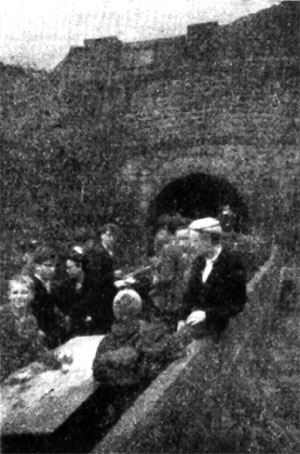
Besides ourselves, the other passengers included a small party of canal enthusiasts from Coventry, one or two keen individuals, and a reporter for the "Yorkshire Evening News." Our party had speculated throughout the journey as to the kind of craft it would be in which we would undertake this memorable expedition. Soon we saw it, moored beside the canal bank, and approached by a very pleasant walk along the towing path. It was obviously of great age, possibly a converted Anglo-Saxon longship for all we knew; it bore some resemblance to one. We were assured that it was reasonably canal worthy and that it was one of the few surviving examples of a dumb-boat, a 70 foot long unpowered barge about 8 feet wide that used to be a familiar sight on the canal until about 1921 when traffic ceased.
The equipment included an old kitchen table (here was real luxury) but no chairs. Light was provided by seveial large paraffin lamps which proved very effective in penetrating the canal gloom, and there were also some rather promising containers. When all were aboard, the motor was started and we chugged into the tunnel, steered by a helmsman at an enormous rudder, whilst another man stationed in the bows with a boat hook deftly manoeuvred our craft along the narrow channel barely nine feet wide and about 6 feet deep. The height of the roof allowed us to stand upright all the time, and although it was two and a half hours before we emerged at Diggle it was an interesting journey. The boys extracted all kinds of information about the construction of the tunnel, and several of the more knowledgeable adults explained that only picks and shovels and chisels were used, with dynamite charges to loosen the rock. It was particularly fascinating when we passed the enormous circular openings in the roof which were the ventilation shafts rising 600 feet to the open moor by the A62 road, and down which welcome draughts of cool fresh air occasionally helped to disperse the petrol fumes and engine smoke from the railway. Several boys collected examples of the rather unusual type of stalactite that hung from the roof.
About halfway we stopped and it was then, when the engine was quiet that we realised what an eerie place this was, deep down in the heart of the Pennines. But only until the contents of those promising containers had revealed themselves to be hot coffee and biscuits, and then there was great enthusiasm for this very welcome repast. Some took the opportunity of scrambling through the "headings" connecting the canal tunnel with the down line of the Leeds to Manchester railway. Once the journey was resumed, it seemed only a comparatively short time before we were emerging at Diggle into the open air and the rain!
After eating our packed lunches in the shelter of Diggle Primary School, by kind permission of the headmaster, a friend of Mr. Wells, we set out to walk to Denshaw thinking the rain might cease. Unfortunately we encountered several very heavy showers in the vicinity of the Roman Fort at Castleshaw, and were so wet on arrival at the 'bus stop that it was wisest to go straight home and change.
This was a rather depressing anticlimax to an otherwise extremely memorable occasion, and for which we are grateful to the British Transport Commission.